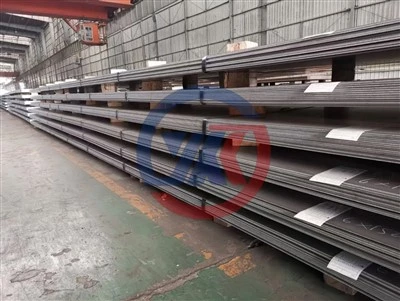
ABS EH36 Steel Specification: The Industry Standard for High-Strength Shipbuilding
In the world of marine engineering and offshore construction, material selection is not just about structural integrity-it is about survival. Vessels and offshore platforms face extreme conditions: corrosive saltwater, massive wave impacts, low temperatures, and heavy dynamic loads.
This is where ABS EH36 comes into play. As part of the American Bureau of Shipping (ABS) high-strength steel grades, EH36 is specifically designed for harsh environments. It is the material of choice for shipbuilders and offshore fabricators who require a balance of high strength, weldability, and-most critically-low-temperature toughness.
This article provides an in-depth look at the ABS EH36 steel specification, covering its chemical composition, mechanical properties, impact testing requirements, and typical applications.
Click to obtain the quote within 24 hours
What is ABS EH36
Breaking down the "EH36" designation
E: Indicates the grade level and impact test temperature requirement. Specifically, "E" requires Charpy V-Notch (CVN) impact testing at -40°C (-40°F) .
H: Denotes "High Tensile Strength" steel.
36: Refers to the minimum yield strength of 36,000 psi (approximately 355 MPa or 51 ksi) .
It is distinct from lower grades like AH36 (tested at 0°C) and DH36 (tested at -20°C). The colder the service environment, the higher the letter grade required .
Key Specifications & Standards
Standard: ABS Rules for Materials and Welding (Part 2).
Equivalent Standards: While ABS is specific to the American Bureau of Shipping, EH36 aligns closely with ASTM A131 Grade EH36 and EN 10225.
Thickness Range: Typically available from 6mm to 240mm, depending on the mill .
Chemical Composition (Heat Analysis)
| Element | Requirement (Max % unless specified) |
|---|---|
| Carbon (C) | 0.18 |
| Manganese (Mn) | 0.90 – 1.60 |
| Silicon (Si) | 0.10 – 0.50 |
| Phosphorus (P) | 0.035 |
| Sulfur (S) | 0.035 |
| Niobium (Nb) | 0.02 – 0.05 |
| Vanadium (V) | 0.05 – 0.10 |
| Aluminum (Al) | 0.015 min |
Mechanical Properties
| Property | Value (Minimum) |
|---|---|
| Yield Strength (ReH) | 355 MPa (51 ksi) |
| Tensile Strength (Rm) | 490 – 620 MPa (71 – 90 ksi) |
| Elongation (A5) | 21% (Often 22% in thinner gauges) |
The Critical Difference: Low-Temperature Impact Toughness
The "E" in EH36 is its defining feature. It is tested using the Charpy V-Notch (CVN) impact test at -40°C. This simulates the freezing conditions of the North Atlantic or Arctic routes.
ABS EH36 Impact Requirements (Longitudinal):
Average Energy: 34 Joules (25 ft-lbs) minimum.
Individual Value: 24 Joules (17 ft-lbs) minimum .
This level of toughness ensures that if a crack initiates, it will not propagate catastrophically in cold waters.
Special Variants: Z-quality (Z25 / Z35)
For critical applications where the steel will be subjected to through-thickness stress (e.g., thick nodes on offshore platforms, crane pedestals), ABS EH36 is often ordered with "Z" properties.
EH36 Z25: Requires 25% reduction of area in through-thickness tensile testing.
EH36 Z35: Requires 35% reduction of area .
Z-quality steel is vacuum-treated to reduce inclusions (sulfur content) and minimize the risk of lamellar tearing, a type of cracking that occurs parallel to the rolling surface when welding thick plates.
Detailed Explanation of Core Differences
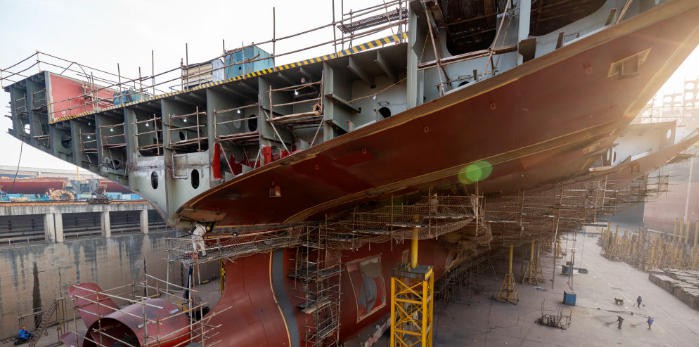
Ship Hull Construction
Specifically for the sheer strake (the top row of plates at the main deck) and strength deck, where stresses are highest.
Ice-Breaking Vessels
The extreme low-temperature toughness allows vessels to operate safely in polar regions .
Offshore Drilling Rigs And Container Ships
Used in the legs and jack-houses of jack-up rigs, as well as semi-submersible platforms.
Used for the upper deck and hatch side coamings to carry the high torsional loads of large container stacks.
Professional technicians' answers

who choose us?
We promise to provide genuine and verifiable factory certification certificates from the Classification Society (ABS steel) and product inspection certificates along with the goods. This is a crucial requirement for the shipyard's warehouse acceptance process.
Common specifications (ABS 6-40mm) are in ample supply and can be cut to any length as per customer requirements. This feature helps shipyards reduce waste from leftover materials and lower procurement costs.
Based on the size of the order and the history of cooperation, we can offer competitive payment terms to help the shipyard optimize its cash flow.
one-stop solution
professional team
high quality
Choose YUXIN steel group, and what you purchase is not merely the steel plates, but also a complete warranty system and a sense of responsibility.
Our address
Tianjin, China
Phone Number
(86)-15937221771(WeChat)
(86)-15837212056(WhatsApp)
info@chinasteelcompany.com

FAQ

01.What is the difference between ABS AH36, DH36, and EH36?
All three are high-strength marine steels with the same minimum yield strength of 355 MPa (51 ksi). The only difference is the Charpy V-Notch impact test temperature:
AH36: Tested at 0°C (32°F) – suitable for tropical and temperate waters.
DH36: Tested at -20°C (-4°F) – suitable for cold regions.
EH36: Tested at -40°C (-40°F) – required for Arctic and sub-Arctic service.
For vessels operating in the North Atlantic or polar routes, ABS EH36 is mandatory for critical structural areas.
02.Can ABS EH36 be welded without preheating?
Not always. While EH36 has good weldability thanks to controlled carbon equivalent (CEV), preheating is required under certain conditions:
Plate thickness > 20mm
Ambient temperature below 0°C (32°F)
High restraint joints (e.g., thick-to-thick plate connections)
Always use low-hydrogen electrodes (E7016 or E80XX series) and follow qualified welding procedure specifications (WPS). For thick sections, a preheat of 50–100°C is typical. Failing to preheat can cause hydrogen-induced cold cracking.
03.What does "Z35" mean in ABS EH36 Z35?
Z35 refers to through-thickness ductility (Z-direction) according to EN 10164 or similar standards.
Standard EH36: Has no guaranteed through-thickness performance. Under high welding restraint, it may suffer lamellar tearing (cracking parallel to the plate surface).
EH36 Z35: Guarantees a minimum 35% reduction of area in through-thickness tensile testing. It also has reduced sulfur content (typically <0.010%) to minimize elongated inclusions.
When to use EH36 Z35: Thick nodes on offshore platforms, crane pedestals, and any joint where high shrinkage stresses act perpendicular to the plate face.

China one-stop steel processing procurement
Through years of understanding and precipitation of steel, Yuxin Group has now become a mature steel processing and manufacturer, providing various products for many construction companies and steel structure companies around the world. Thanks to Yuxin Group's professionalism and integrity, it has become a world-renowned enterprise.