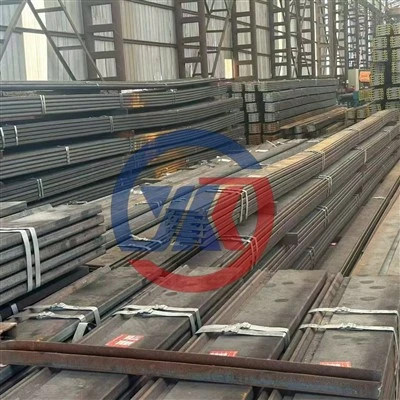
The Ultimate Guide to Bulb Flats: The "Invisible Backbone" of Shipbuilding & Offshore Engineering
If you are reading this, chances are you are a naval architect, offshore structural engineer, procurement specialist, or an industry professional seeking in-depth technical knowledge about specialty steel sections. In this comprehensive guide, we cut through the noise to explore bulb flats-one of the most critical yet underappreciated steel profiles in marine and heavy construction. We will cover their core applications, undeniable engineering advantages, global standards, and emerging market trends.
What Are Bulb Flats?
A bulb flat, also known as a bulb plate or bulb section, is a hot-rolled structural steel shape with a distinct cross-sectional geometry. It essentially consists of a flat steel web with a thickened, protruding "bulb" or "bulbous" edge running along one side.
This seemingly simple design is the result of decades of engineering optimisation, delivering performance that far exceeds its visual simplicity.
Primary Application: Plate Stiffening
The primary and most dominant use of bulb flats is as plate stiffeners (stiffening ribs) in large steel-plated structures, particularly within the shipbuilding and offshore engineering sectors.
When you examine a massive container vessel, LNG carrier, FPSO, or offshore drilling platform, the outer hull, decks, and bulkheads are not made of single, unreinforced thick steel plates. Instead, they consist of thinner steel plates reinforced by a grid of welded stiffeners. Bulb flats are the industry-preferred profile for this role.
Why Bulb Flats? Three Engineering Advantages
Superior Strength-to-Weight Ratio
The unique bulbous end dramatically increases the section's moment of inertia without adding excessive weight. This provides exceptional resistance to local buckling under compressive and shear loads.
By using bulb flats, designers can significantly reduce the overall lightweight (deadweight) of the vessel, directly translating into greater cargo capacity, improved fuel efficiency, and lower operational costs-critical factors in commercial shipping.
Inherent Corrosion Resistance (Debris Shedding)
Unlike angle bars, which feature sharp internal corners, bulb flats have a smooth, radiused contour. This geometry prevents the accumulation of dirt, moisture, salt, and corrosive debris in tight crevices.
In harsh marine environments, this design drastically simplifies coating application, reduces the risk of crevice corrosion, and extends the maintenance intervals and service life of the entire structure.
Fabrication Efficiency
Bulb flats feature a perfectly straight, flat flange that enables fast, reliable, and distortion-free fillet welding onto the base plate. Their standardised dimensions and predictable mechanical properties allow for straightforward structural calculations and streamlined automated welding processes in modern shipyards.
Key Application Scenarios
Architectural design & planning cepteur sint occaecat cupidatat proident

Merchant & Naval Vessels
From ultra-large container ships, bulk carriers, and oil tankers to naval frigates and amphibious assault ships-bulb flats are extensively used in shell plating, deck stiffening, and transverse bulkhead framing.

Offshore & Subsea Structures
Floating Production Storage and Offloading units (FPSOs), semi-submersible rigs, and jacket foundations depend on bulb flats to reinforce high-stress plate panels against wave-induced fatigue and hydrostatic pressure.

Heavy Civil & Infrastructure
In some specialised cases, bulb flats are also specified for large steel bridges, gantry cranes, and lock gates where lightweight stiffening is paramount.
Dimensional & Tolerances Standards
ISO 657-19 (Hot-rolled steel sections - Bulb flats)
EN 10067 (Hot-rolled bulb flats - Tolerances on shape and dimensions)
JIS G 3192 (Japanese Industrial Standard for rolled steel shapes)
GB/T 11264 (Chinese National Standard for hot-rolled bulb flats)
IS 1863 (Indian standard for bulb flats)
BS 4848-5 (British standard – metric bulb flats)
Critical: Classification Society Approvals
To be used in commercial shipbuilding, bulb flat products must carry type approval or product certification from major classification societies. Key bodies include:
ABS (American Bureau of Shipping)
LR (Lloyd's Register)
DNV (Det Norske Veritas)
BV (Bureau Veritas)
NK (Nippon Kaiji Kyokai / ClassNK)
RINA (Registro Italiano Navale)
These societies verify chemical composition, mechanical properties (yield/tensile strength), impact toughness, and dimensional accuracy.

Conclusion
Bulb flats may not command the spotlight like high-tensile plates or cast steel components, but they are undeniably the invisible backbone of modern shipbuilding and offshore engineering. Their unparalleled combination of lightweight efficiency, structural integrity, corrosion-friendly geometry, and fabrication economy makes them the irreplaceable choice for plate stiffening in the world's most demanding marine environments.
Next time you see a colossal vessel slicing through the ocean, remember: beneath the paint, thousands of bulb flats are silently working together, ensuring strength, safety, and performance in every wave.
one-stop solution
professional team
high quality
Choose YUXIN steel group, and what you purchase is not merely the steel plates, but also a complete warranty system and a sense of responsibility.
Our address
Tianjin, China
Phone Number
(86)-15937221771(WeChat)
(86)-15837212056(WhatsApp)
info@chinasteelcompany.com

FAQ

01.What is the main difference between a bulb flat and a flat bar for stiffening?
02.Are bulb flats difficult to weld, and what precautions should be taken?
Bulb flats are designed for excellent weldability, but precautions are necessary due to their high-strength variants and the heat-affected zone (HAZ) sensitivity. Key considerations include:
Preheating: Higher-strength grades (DH36/EH36) may require preheating (typically 50°C – 100°C) to prevent hydrogen-induced cold cracking, especially in thick sections or humid environments.
Low-Hydrogen Electrodes: Always use low-hydrogen welding consumables (e.g., E7018 or equivalent) for high-strength bulbs.
Fillet Weld Size: Ensure the weld throat thickness meets the classification society's minimum requirements-often specified relative to the bulb's web thickness.
Approved WPS: A Welding Procedure Specification (WPS) qualified under the relevant classification society (e.g., ABS, DNV) is strictly mandatory for any structural welding on certified vessels.

China one-stop steel processing procurement
Through years of understanding and precipitation of steel, Yuxin Group has now become a mature steel processing and manufacturer, providing various products for many construction companies and steel structure companies around the world. Thanks to Yuxin Group's professionalism and integrity, it has become a world-renowned enterprise.