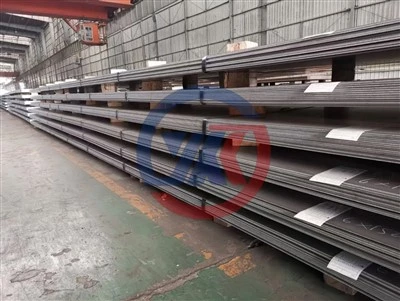
CCS AH36 Marine Steel Plate: A Comprehensive Industry Guide
CCS AH36 marine steel plate is a high-strength hull structural steel certified by the China Classification Society (CCS). It is one of the core materials used in the construction of modern large vessels and offshore engineering equipment.
In shipbuilding, material selection directly impacts vessel safety, durability, and economic viability. To fully understand the value of CCS AH36, we need to examine its designation, critical performance characteristics, and industry applications.
Decoding the Designation
| Component | Meaning |
|---|---|
| CCS | China Classification Society certification – The steel plate has passed strict inspection and approval by CCS, ensuring its manufacturing process and product quality comply with the Society's Rules for Materials and Welding. |
| A | Quality grade – In marine steel, quality grades range from A to E, differentiated primarily by low-temperature impact toughness. Grade A requires impact testing at 0°C, while Grades D and E require testing at -20°C and -40°C, respectively. Higher grades offer better resistance to brittle fracture at low temperatures. |
| H36 | High-strength characteristic – "H" stands for "High Strength," and "36" denotes a minimum yield strength of 355 MPa. For reference, ordinary-strength marine steels (such as Grades A, B, and D) have a yield strength of 235 MPa. |
Key Performance Properties
The high strength of CCS AH36 is achieved through precise chemical composition control and advanced manufacturing processes.
Chemical Composition & Microalloying
Carbon content: ≤ 0.18%
Impurities: Phosphorus (P) and sulfur (S) are strictly limited
Microalloying elements: Niobium (Nb), vanadium (V), and titanium (Ti) are added in small quantities (e.g., Nb: 0.02%–0.05%, V: 0.05%–0.10%) to refine grain size – this is the key to achieving both high strength and high toughness.
Carbon Equivalent (Ceq): For plates up to 50 mm in thickness, the Ceq must be ≤ 0.38% per CCS rules, ensuring good weldability.
Mechanical Properties (for thickness ≤ 50 mm)
| Property | Requirement |
|---|---|
| Minimum Yield Strength | 355 MPa |
| Tensile Strength Range | 490 – 620 MPa |
| Impact Test Temperature | 0°C (Grade A requirement) |
| Elongation | ≥ 21% (typical, per CCS rules) |
Delivery Conditions
CCS AH36 plates are typically supplied in one of the following states:
Hot-rolled (as-rolled)
Normalized (N)
Thermo-Mechanical Controlled Process (TMCP)
Among these, the TMCP process – which combines controlled rolling and controlled cooling – delivers superior comprehensive mechanical properties and is frequently used for producing thicker, high-performance plates.
Wide-Ranging Applications
Thanks to its high strength and well-balanced overall performance, CCS AH36 steel plate is extensively used in high-stress areas of ship hulls and offshore structures.
Shipbuilding
Strength deck – the uppermost continuous deck that resists longitudinal bending
Bottom shell plating – the outer bottom structure subjected to severe wave loads
Side shell plating – the side structure of the hull
Hatch coamings – structures surrounding cargo hatch openings
By using higher-strength AH36, designers can use thinner plates to achieve the same structural strength, thereby reducing hull weight and increasing cargo capacity.
Offshore Engineering
Offshore platforms
Floating production storage and offloading units (FPSOs)
Jack-up rigs and semi-submersible platforms.
Comparison with Ordinary-Strength Marine Steel
| Parameter | CCS AH36 (High-Strength) | CCS Grade A (Ordinary-Strength) |
|---|---|---|
| Minimum Yield Strength | 355 MPa | 235 MPa |
| Tensile Strength | 490–620 MPa | 400–520 MPa |
| Impact Test Temp | 0°C | 0°C |
| Typical Applications | High-stress hull members | General hull structures (non-critical areas) |
| Cost | Higher | Lower |

Summary
CCS AH36 marine steel plate is a high-strength structural steel certified by the China Classification Society. With its 355 MPa minimum yield strength and reliable low-temperature toughness at 0°C, it is a preferred material for modern ship hulls and offshore engineering structures. Its superior performance relies on microalloyed composition design and advanced TMCP or normalized rolling processes.
As the global shipbuilding industry continues to demand larger, lighter, and more fuel-efficient vessels, high-strength steels like CCS AH36 will remain indispensable. Meanwhile, domestic Chinese producers are ramping up their certified production capabilities to meet both domestic and international market needs.
one-stop solution
professional team
high quality
Choose YUXIN steel group, and what you purchase is not merely the steel plates, but also a complete warranty system and a sense of responsibility.
Our address
Tianjin, China
Phone Number
(86)-15937221771(WeChat)
(86)-15837212056(WhatsApp)
info@chinasteelcompany.com

FAQ

01.What does "CCS AH36" stand for?
CCS = China Classification Society (certification)
A = Quality grade (impact tested at 0°C)
H36 = High-strength steel with 355 MPa minimum yield strength
02.How does CCS AH36 differ from ordinary Grade A steel?
03.Is CCS AH36 easy to weld?
04.Where is CCS AH36 typically used?
It is used in high-stress areas of ship hulls and offshore structures, including:
Strength decks
Bottom and side shell plating
Hatch coamings
Offshore platforms and FPSOs

China one-stop steel processing procurement
Through years of understanding and precipitation of steel, Yuxin Group has now become a mature steel processing and manufacturer, providing various products for many construction companies and steel structure companies around the world. Thanks to Yuxin Group's professionalism and integrity, it has become a world-renowned enterprise.