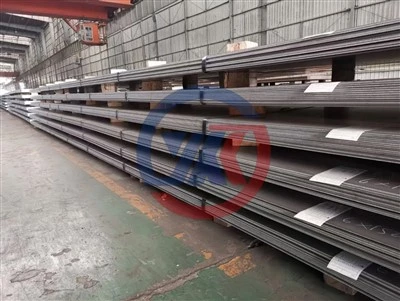
ABS EH36 vs. AH36 Steel Plates: A Detailed Comparison for Shipbuilding
ABS EH36 and AH36 are both high-strength structural steel grades certified by the American Bureau of Shipping (ABS) for marine and offshore applications. They belong to the same family of higher-strength shipbuilding steels, alongside DH36, and share the same minimum yield strength of 355 MPa (51 ksi) . While they are often used interchangeably for general hull construction, the critical difference lies in their low-temperature impact toughness, which dictates their suitability for different operating environments.
This article provides a comprehensive comparison of EH36 and AH36, focusing on their mechanical properties, chemical composition, and typical applications.
ABS AH36 and EH36 are high-strength, low-alloy (HSLA) steels designed for the construction of ship hulls, superstructures, and offshore platforms. Both grades are renowned for their excellent weldability and toughness, making them mainstays in commercial shipbuilding worldwide.
The designation system is as follows:
ABS: Certified by the American Bureau of Shipping.
A/E: Grade level indicating the impact testing temperature (A for 0°C, E for -40°C).
H: High-strength material.
36: Minimum yield strength of 355 MPa (51 ksi).
Mechanical Properties: The Key Difference
The most significant difference between AH36 and EH36 lies in their Charpy V-notch (CVN) impact test temperature. This test measures a material's ability to absorb energy during fracture, and performing it at lower temperatures ensures the steel remains tough and resists brittle failure in cold environments.
| Property | AH36 | EH36 |
|---|---|---|
| Yield Strength (min) | 355 MPa (51 ksi) | 355 MPa (51 ksi) |
| Tensile Strength | 490 – 620 MPa (71 – 90 ksi) | 490 – 620 MPa (71 – 90 ksi) |
| Elongation (min) | 22% | 22% |
| Impact Test Temperature | 0°C (32°F) | -40°C (-40°F) |
| Min. Impact Energy | 34 J (longitudinal) / 24 J (transverse) | 34 J (longitudinal) / 24 J (transverse) |
As the table shows, while tensile and yield strength are identical for both grades, EH36 is tested at a significantly lower temperature. This means EH36 can maintain its toughness in much colder conditions than AH36.
Chemical Composition
The chemical composition of AH36 and EH36 is very similar, which is why they share comparable mechanical strength and weldability. Both grades have tightly controlled carbon content and the addition of microalloying elements like niobium (Nb) and vanadium (V) to achieve their high strength through grain refinement and precipitation strengthening.
| Element | AH36 (max %) | EH36 (max %) |
|---|---|---|
| Carbon (C) | 0.18 | 0.18 |
| Manganese (Mn) | 0.90 – 1.60 | 0.90 – 1.60 |
| Silicon (Si) | 0.10 – 0.50 | 0.10 – 0.50 |
| Phosphorus (P) | 0.035 | 0.035 |
| Sulfur (S) | 0.035 | 0.035 |
| Aluminum (Al) | 0.015 (min) | 0.015 (min) |
| Niobium (Nb) | 0.02 – 0.05 | 0.02 – 0.05 |
| Vanadium (V) | 0.05 – 0.10 | 0.05 – 0.10 |
Some sources indicate EH36 may have slightly higher allowable limits for certain alloying elements like nickel (Ni) or chromium (Cr) to enhance its toughness at low temperatures, but the general specification limits remain very similar across the grades.
Applications and Selection
The primary difference in impact temperature determines the typical applications for each grade:
AH36 (Tested at 0°C): This is the standard choice for general ship hull structures and decks operating in temperate marine environments where temperatures are not expected to drop below freezing. It is commonly used in cargo ships, bulk carriers, and container ships sailing in non-polar regions.
EH36 (Tested at -40°C): This grade is selected for vessels and structures that will operate in severe, cold environments, including Arctic and Antarctic regions. Its superior low-temperature toughness makes it ideal for icebreakers, polar supply vessels, LNG carriers, and offshore platforms in high-latitude areas where the risk of brittle fracture is significantly higher.
Weldability and Fabrication
Both AH36 and EH36 are known for their excellent weldability. However, because EH36 is intended for more critical, low-temperature applications, welding procedures and filler metal selection may be more stringent .
Filler Metals: For welding EH36, it is recommended to use filler metals with an ABS 4YSA or higher classification to ensure the weld metal possesses the necessary toughness at -40°C.
Welding Processes: Common processes like flux-cored arc welding (FCAW) and submerged arc welding (SAW) are used for both grades, but the specific consumables and their certification are matched to the required impact properties.
Summary Comparison
The table below summarizes the key distinctions for quick reference:
| Feature | AH36 | EH36 |
|---|---|---|
| Grade Designation | A (impact tested at 0°C) | E (impact tested at -40°C) |
| Impact Test Temperature | 0°C (32°F) | -40°C (-40°F) |
| Yield Strength | 355 MPa | 355 MPa |
| Tensile Strength | 490–620 MPa | 490–620 MPa |
| Typical Applications | General hull structures, temperate climates | Arctic vessels, icebreakers, polar offshore |
| Filler Metal Example | ABS 3YSA Class | ABS 4YSA or 5Y400 Class |

Conclusion
In summary, while ABS EH36 and AH36 are virtually identical in terms of strength, their key differentiator is the Charpy V-notch impact test temperature. AH36 is sufficient for most standard shipbuilding applications in temperate climates, while EH36 is the mandatory choice for projects where the steel will be exposed to sub-zero temperatures. This fundamental difference in low-temperature toughness ensures that the steel will retain its ductility and resist catastrophic brittle fracture in its intended service environment. For engineers and procurement professionals, the selection between the two comes down to a simple question: "What is the minimum operating temperature?"
one-stop solution
professional team
high quality
Choose YUXIN steel group, and what you purchase is not merely the steel plates, but also a complete warranty system and a sense of responsibility.
Our address
Tianjin, China
Phone Number
(86)-15937221771(WeChat)
(86)-15837212056(WhatsApp)
info@chinasteelcompany.com

FAQ

01.Are AH36 and EH36 the same strength?
02.Can I use AH36 instead of EH36 to save cost?
03.Do AH36 and EH36 require different welding procedures?
04.Is there a grade with even lower impact temperature than EH36?

China one-stop steel processing procurement
Through years of understanding and precipitation of steel, Yuxin Group has now become a mature steel processing and manufacturer, providing various products for many construction companies and steel structure companies around the world. Thanks to Yuxin Group's professionalism and integrity, it has become a world-renowned enterprise.