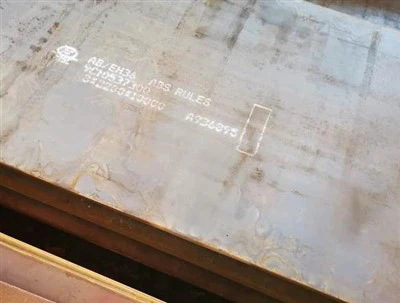
The Strong, Reliable Steel for Marine and Offshore Projects
Choosing the right steel for shipbuilding and offshore platforms is critical. You need a material that combines high strength, excellent weldability, and the toughness to withstand harsh marine environments. ABS DH36 shipbuilding steel plate is the industry-preferred solution for hull structures, offshore drilling rigs, and other critical marine applications .
Our ABS Grade DH36 steel plate is manufactured to meet the rigorous standards of the American Bureau of Shipping (ABS), ensuring your project is built on a foundation of safety and durability.
Click to obtain the latest technical parameters
Key Specifications & Mechanical Properties
Our ABS DH36 ship plate offers a balanced combination of strength and toughness, making it ideal for structural applications where reliability is paramount .
| Grade | Thickness Range | Yield Strength (Min) | Tensile Strength | Elongation (Min) |
|---|---|---|---|---|
| ABS DH36 | 8mm - 100mm+ | 355 MPa (51 ksi) | 490 - 620 MPa | 21% |
Chemical Composition (Heat Analysis)
| Element | C | Si | Mn | P | S | Ni | Cr | Mo | Nb | V | Al |
|---|---|---|---|---|---|---|---|---|---|---|---|
| Value % | ≤0.18 | 0.1-0.5 | 0.9-1.6 | ≤0.035 | ≤0.035 | ≤0.40 | ≤0.20 | ≤0.08 | 0.02-0.05 | 0.05-0.10 | ≥0.015 |
Low-Temperature Impact Toughness
A key feature of ABS DH36 steel is its guaranteed impact toughness in cold conditions. Unlike standard grades, it is tested at -20°C to ensure it won't become brittle in cold seawater . This is a critical safety factor for vessels operating in winter conditions or cold-water regions.
Dimensional Tolerances & Supply Specifications
Our ABS DH36 shipbuilding steel plates are manufactured and inspected in strict accordance with ABS Rules and ASTM A6/A6M standards, ensuring dimensional accuracy that meets the demanding requirements of shipbuilding and offshore construction. Below are our standard supply ranges and key tolerance information:
| Parameter | Standard Supply Range | Tolerance / Remarks |
|---|---|---|
| Thickness | 5mm – 150mm | Thickness tolerances strictly follow ASTM A6/A6M. For plates ≤15mm, the minus tolerance is controlled to no more than -0.4mm. |
| Width | 1200mm – 4200mm | Tolerances vary by final size. Custom cutting to your engineering drawings is available upon request. |
| Length | 3000mm – 18000mm | Length tolerance is typically 0 to +100mm, accommodating large block fabrication. |
| Flatness | ≤ 10mm per meter (for thickness ≥ 4mm) | Meets strict classification society requirements, ensuring easy welding and assembly. |
What is the Difference Between AH36 and DH36?
Both grades have the same strength. The main difference is their impact test temperature.

Impact tested at 0°C (suitable for standard environments).

ABS DH36 shipbuilding steel plate
Impact tested at -20°C (safer for cold-water marine environments)
For projects requiring even higher performance in polar regions, we also supply ABS EH36 (tested at -40°C) and ABS FH36 (tested at -60°C)
3 Key Features of ABS DH36 Shipbuilding Steel Plate
One-stop steel procurement

High Strength with Low-Temperature Toughness
355 MPa minimum yield strength combined with -20°C impact resistance – this means your structure stays strong and safe even in freezing seawater, reducing the risk of brittle fracture in cold climates.

Excellent Weldability & Fabrication Ease
Low carbon equivalent (CEV) allows easy welding without extensive preheating. This saves fabrication time, lowers labor costs, and reduces the risk of weld cracking – a major advantage for busy shipyards.

Fully Certified & Traceable
Every plate comes with official Mill Test Certificates (MTC) and is approved by major classification societies including ABS, DNV, LR, BV, and CCS. Full material traceability gives you peace of mind for safety-critical marine projects.
Applications | Where is ABS DH36 Steel Used?

Ship Hull Structures & Vessel Construction
Outer hull shells that directly face seawater impact and wave pressure.
Inner bottom plates and double-bottom structures that support cargo weight.
Deck structures that bear heavy loads from equipment and containers.
Bulkheads and transverse frames that maintain the ship's structural integrity.
Offshore Drilling Platforms & Jack-Up Rigs
Jack-up rig legs and chords that support the entire platform weight.
Helidecks that must withstand helicopter landings and dynamic loads.
Subsea support structures and pile sleeves that anchor the platform to the seabed.
Crane pedestals and heavy equipment foundations on the main deck.


Heavy-Duty Marine Equipment & Port Infrastructure
Ship-to-shore (STS) container gantry cranes that handle massive container loads.
Graving dock gates and caisson doors that seal dry docks during repairs.
Mooring dolphins, bollards, and fender panels that absorb ship impact forces.
Offshore loading buoys and submarine pipeline risers that connect seabed wells to surface facilities.
Ship Repair, Retrofitting & Conversion Projects
Replacing corroded or cracked hull sections during dry-dock maintenance.
Strengthening older vessels to carry heavier cargo or comply with new stability rules.
Adding new deck extensions or superstructures for vessel conversions (e.g., converting an oil tanker into an FPSO unit).
Reinforcing hatch coamings and cargo hold boundaries to prevent water ingress.


Why Choose Our ABS DH36 Steel Plate?
Full Certification: We provide official Mill Test Certificates (MTCs) with full traceability. Our plates are approved by major classification societies including ABS, CCS, DNV, LR, and BV .
Excellent Weldability: The low carbon equivalent (CEV) of our [DH36 marine steel plate] makes it easy to weld using standard methods like submerged arc welding, minimizing preheating requirements and reducing fabrication costs .
Versatile Applications: Widely used in ship hulls, deck structures, offshore platforms, hatch coamings, and other critical load-bearing components .
Z-Property Options: For projects requiring resistance to lamellar tearing in through-thickness applications, we can supply ABS DH36 Z25 and Z35 grades .
Get the quotation within 24 hours
one-stop solution
professional team
high quality
our Partners
We trusted by


Carlos M.
Procurement Manager, Brazil

Kenji T.
Project Engineer, Japan

Ahmed R.
Offshore Construction Director, UAE
FAQ

01.What is the difference between ABS DH36 and ABS AH36?
Both grades have the same strength (355 MPa yield). The key difference is the impact test temperature:
AH36 is tested at 0°C – suitable for standard marine environments.
DH36 is tested at -20°C – safer for cold-water routes and winter conditions.
For polar regions, we also supply EH36 (-40°C) and FH36 (-60°C).
02.What sizes and thicknesses do you offer?
03.Do you provide mill test certificates and third-party inspection?
04.What is the minimum order quantity (MOQ)?
There is no fixed MOQ for our ABS DH36 plates. We welcome both small-batch orders for repair projects and bulk orders for new shipbuilding. Contact us with your quantity, and we will provide a competitive quote with flexible delivery terms.
Hot Tags: ABS DH36 Shipbuilding Steel Plate High-Strength Marine Steel for Ship & Offshore Projects, China ABS DH36 Shipbuilding Steel Plate High-Strength Marine Steel for Ship & Offshore Projects suppliers, blasted shipbuilding steel plate, ground shipbuilding steel plate, retail shipbuilding steel plate, scheduled shipbuilding steel plate, shelved shipbuilding steel plate, stock shipbuilding steel plate