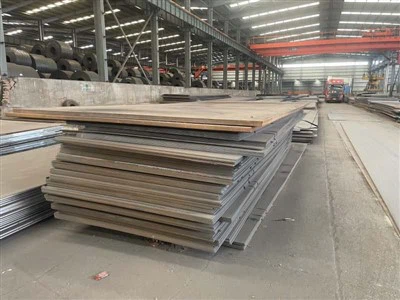
As a supplier of carbon steel plates, I often get asked about the differences between hot-rolled and cold-rolled carbon steel plates. It's a common question, and the answer isn't always straightforward. In this blog post, I'll break down the key differences between these two types of steel plates to help you decide which one is better for your specific needs.
What are Hot-Rolled and Cold-Rolled Carbon Steel Plates?
Let's start with the basics. Hot-rolled carbon steel plates are made by heating a steel billet or slab above its recrystallization temperature and then passing it through a series of rollers. This process makes the steel easier to shape and form, and it results in a plate with a slightly rough surface finish. On the other hand, cold-rolled carbon steel plates are made by rolling the steel at room temperature. This process gives the steel a smoother surface finish and tighter tolerances, but it also makes the steel harder and less ductile.
Surface Finish
One of the most noticeable differences between hot-rolled and cold-rolled carbon steel plates is their surface finish. Hot-rolled plates have a scaly, rough surface due to the oxidation that occurs during the hot-rolling process. This surface finish is not ideal for applications where appearance is important, but it's perfectly fine for structural applications where strength is the primary concern.
Cold-rolled plates, on the other hand, have a smooth, shiny surface finish. This makes them a great choice for applications where appearance is important, such as automotive parts, appliances, and furniture. The smooth surface also makes cold-rolled plates easier to paint or coat.
Dimensional Accuracy
Cold-rolled carbon steel plates generally have better dimensional accuracy than hot-rolled plates. The cold-rolling process allows for tighter tolerances, which means that the plates are more consistent in terms of thickness, width, and length. This is important for applications where precise dimensions are required, such as in the manufacturing of machinery and equipment.
Hot-rolled plates, on the other hand, may have slightly more variation in their dimensions. This is because the hot-rolling process can cause the steel to expand and contract, which can affect the final dimensions of the plate. However, for many structural applications, this variation is not a significant issue.
Strength and Ductility
Hot-rolled carbon steel plates are generally stronger and more ductile than cold-rolled plates. The hot-rolling process allows the steel to recrystallize, which results in a more uniform grain structure and improved mechanical properties. This makes hot-rolled plates a great choice for applications where strength and ductility are important, such as in the construction of bridges and buildings.
Cold-rolled plates, on the other hand, are harder and less ductile than hot-rolled plates. The cold-rolling process work-hardens the steel, which increases its strength but reduces its ductility. This makes cold-rolled plates a good choice for applications where hardness and wear resistance are important, such as in the manufacturing of tools and dies.
Cost
Cost is always a factor when choosing between hot-rolled and cold-rolled carbon steel plates. Generally speaking, hot-rolled plates are less expensive than cold-rolled plates. This is because the hot-rolling process is less complex and requires less energy than the cold-rolling process. However, the cost difference can vary depending on the specific requirements of your project.
Applications
The choice between hot-rolled and cold-rolled carbon steel plates ultimately depends on the specific requirements of your application. Here are some common applications for each type of plate:
Hot-Rolled Carbon Steel Plates
- Structural applications: Hot-rolled plates are commonly used in the construction of bridges, buildings, and other structures where strength and ductility are important.
- Pipe and tube manufacturing: Hot-rolled plates are often used to make pipes and tubes for various industries, including oil and gas, water treatment, and construction.
- Heavy machinery: Hot-rolled plates are used in the manufacturing of heavy machinery, such as cranes, bulldozers, and excavators.
Cold-Rolled Carbon Steel Plates
- Automotive parts: Cold-rolled plates are commonly used in the manufacturing of automotive parts, such as body panels, doors, and hoods.
- Appliances: Cold-rolled plates are used in the manufacturing of appliances, such as refrigerators, washing machines, and ovens.
- Furniture: Cold-rolled plates are used in the manufacturing of furniture, such as tables, chairs, and cabinets.
Conclusion
In conclusion, both hot-rolled and cold-rolled carbon steel plates have their own unique advantages and disadvantages. The choice between the two depends on the specific requirements of your application, including surface finish, dimensional accuracy, strength, ductility, and cost.
If you're still not sure which type of carbon steel plate is right for your project, feel free to contact us for more information. We're a leading supplier of carbon steel plates, and we can help you find the perfect solution for your needs. Whether you need Carbon Steel Angle Bar, Carbon Steel Plate Price A516 Gr 70, or Round Carbon Steel Bar, we've got you covered.
References
- "Steel Plate: Hot-Rolled vs. Cold-Rolled." The Fabricator, https://www.thefabricator.com/thefabricator/article/materials/steel-plate-hot-rolled-vs-cold-rolled.
- "What's the Difference Between Hot-Rolled and Cold-Rolled Steel?" Metal Supermarkets, https://www.metalsupermarkets.com/whats-the-difference-between-hot-rolled-and-cold-rolled-steel/.
- "Hot-Rolled vs. Cold-Rolled Steel: What's the Difference?" Machine Design, https://www.machinedesign.com/materials/hot-rolled-vs-cold-rolled-steel-whats-difference.