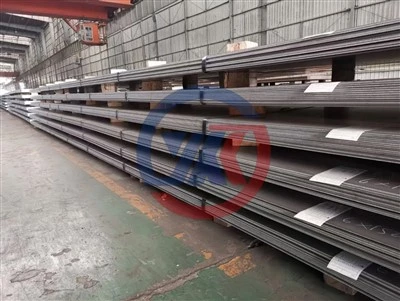
A516GR70 and A516GR70N steel plates comparison in depth: Comprehensive analysis of material selection and performance differences
In the fields of petroleum, chemical engineering and power station equipment manufacturing, the A516GR70 series is the most widely used carbon steel plate for medium and low temperature pressure vessels. However, when purchasing personnel review the technical specifications, they often get confused about the two grades, A516GR70 and A516GR70N: Just a single additional "N" means what exactly? This is not only a difference in technical parameters, but also directly relates to the safe service life of the equipment and the project cost.
This article will be based on the ASME standards and, through a clear comparison table, will provide you with a detailed analysis of the core differences between the two, helping you make the best choice in your purchasing decisions.
Core definition: What does N stand for?
First of all, we need to clarify a concept. A516GR70 is the basic grade under the American Standard (ASTM/ASME). While A516GR70N, the "N" in it clearly indicates that this steel plate has undergone normalizing heat treatment. It can be simply understood as: A516GR70 is the basic version, while A516GR70N is its performance-enhanced version.
Although for A516GR70 steel plates with a thickness exceeding 40mm, the standard usually also requires delivery in the normalized state, for A516GR70N, regardless of the thickness, it must undergo normalization treatment, and this must be clearly indicated in the quality guarantee document.
| A516GR70(Hot rolling or controlled rolling) | A516GR70N (Normalizing) | Technical Interpretation and Material Selection Impact | |
|---|---|---|---|
| Delivery status | It is usually delivered in hot-rolled condition (thickness ≤ 40mm); for those with a thickness greater than 40mm or requiring notch toughness, normalizing treatment is carried out. | The material must undergo normalizing treatment (heated to 920 - 980℃ and then cooled slowly in the air), and the condition must be clearly defined. | N stands for quality assurance: Purchasing A516GR70N means that regardless of thickness, you will obtain a refined grain structure. |
| Microstructure | The grains are relatively coarse and unevenly distributed, with certain internal stresses resulting from the rolling process. | The grains have been refined, the carbides are evenly distributed, and the internal stress has been eliminated. | The microstructure determines the macroscopic properties. The steel plate after normalizing is more stable. |
| Mechanical properties | The tensile strength (485 - 620 MPa) and yield strength (≥ 260 MPa) have met the standards, but the fluctuations may be significant. | While maintaining the strength, the hardness decreases (by no more than 200 HB) and the plasticity increases. | A decrease in hardness indicates better cutting processing performance, and an increase in plasticity is beneficial for cold forming (such as the pressing of head sections). |
| Low-temperature toughness | It can meet the basic requirements, but its impact toughness becomes unstable below -29℃. | Significantly improved, for instance, it can still maintain a relatively high impact energy (≥ 27J) even at -46℃. | This is the most critical safety indicator. It is applicable to low-temperature environments such as liquefied petroleum gas (LPG) storage tanks. |
| Corrosion resistance | Standard tensile strength design, not optimized for acidic environment. | By refining and uniformly organizing, the ability to resist hydrogen-induced cracking (HIC) and sulfide stress corrosion (SSC) is enhanced. | For harsh medium environments containing sulfur and hydrogen (such as desulfurization towers), A516GR70N is a safer option. |
| Application scenario | Ordinary pressure vessels and heat exchangers for normal temperature, low pressure and non-corrosive media. | Low temperature, high pressure, acidic wet H₂S environment, deep well extraction equipment, liquefied gas storage tanks. | Selection principle: The harsher the environment, the more crucial it is to use the annealed plate to ensure long-term operation. |
Get the most favorable price immediately
Why are these differences important for procurement?
Safety Assurance
In low-temperature environments, ordinary hot-rolled plates (A516GR70) may experience brittle fracture. However, A516GR70N eliminates stress concentration through normalizing and refines the grain structure, ensuring excellent toughness even at low temperatures. For example, for liquefied gas storage tanks operating at -40℃, it is necessary to specify the use of steel plates in the normalized state.
Processing performance
The purchased steel plates often need to undergo processes such as rolling and stamping (for making the head). A516GR70N has a lower and more uniform hardness. Not only is it less prone to cracking during processing, but it also reduces tool wear and improves the production efficiency of the equipment factory.
Corrosion resistance lifespan
For equipment exported to high-sulfur oil and gas fields in regions such as the Middle East and North America, it is usually required to comply with the NACE MR0175 standard. A516GR70N, through component optimization and normalizing process, can effectively resist sulfide stress corrosion, which is something that ordinary A516GR70 cannot guarantee.

why choose us?
Are you currently looking for high-quality A516GR70 or A516GR70N steel plates for your export project? We can offer the following services:
Spot check inquiry: We have regular stock available in thickness ranging from 8 to 200mm. We can also provide non-destructive testing (including I/II/III levels) for these products.
Futures Rolling: According to your technical requirements, coordinate with the steel mills to conduct normal heat treatment and HIC tests.
Export services: Provide detailed EN10204 3.2 factory certificates, support third-party inspections, and ensure that the materials meet international standards.
Contact us immediately, upload your drawings or technical requirements, and we will provide you with professional material selection suggestions and the best quotations!
one-stop solution
professional team
high quality
Choose YUXIN steel group, and what you purchase is not merely the steel plates, but also a complete warranty system and a sense of responsibility.
Our address
Tianjin, China
Phone Number
(86)-15937221771(WeChat)
(86)-15837212056(WhatsApp)
info@chinasteelcompany.com

FAQ

01.Could your A516GR70N model provide an HIC (hydrogen-induced cracking resistance) test report?
The regular A516GR70N stock usually only guarantees mechanical properties and flaw detection. If you need to use it in an acidic wet H₂S environment (that is, requiring anti-HIC performance), you must raise this requirement during the rolling scheduling. The steel mill will adjust the composition according to the requirements (such as reducing the P and S content, adding trace elements), and conduct anti-HIC tests. It is recommended to provide your technical specification document at the beginning of the project so that we can coordinate the production schedule for you.
02.Will the performance of A516GR70N with a thickness exceeding 50mm deteriorate?
As the thickness increases, the internal density and cooling rate of the steel plate will slow down, which may result in the core strength being slightly lower than the surface. However, the normalizing process, by refining the grains, maximally ensures the core impact toughness of thick-section steel plates. For extremely thick plates (such as those over 100mm), the steel mills may also adopt accelerated cooling (ACC) or quenching and tempering (QT) processes to supplement the performance. This point needs to be specially noted during the quotation process.
03.What are the differences between A516GR70N and P355NH (European standard container board) in the European standards?
Similarity: Both A516GR70N (American standard) and P355NH (European standard) belong to the type of steel used for pressure vessels with fine-grained normalizing structure, and their yield strength is at the 355 MPa level (with slight differences in thickness).
Main difference: Different impact temperatures. The impact test temperature for A516GR70N is usually determined according to the contract requirements (such as -40℃, -46℃), while for P355NH, the standard typically stipulates a minimum impact energy of -20℃ or -40℃. If you are exporting equipment to regions that use European standards, it is recommended to confirm which specific standard is specified in the contract.
04.Can you provide cutting and processing services?

China one-stop steel processing procurement
Through years of understanding and precipitation of steel, Yuxin Group has now become a mature steel processing and manufacturer, providing various products for many construction companies and steel structure companies around the world. Thanks to Yuxin Group's professionalism and integrity, it has become a world-renowned enterprise.