

Introduction – The Two Most Common Offshore Steel Grades
When sourcing steel for offshore projects - such as jack-up rigs, FPSO hulls, or fixed platforms - two names appear constantly: EH36 and DH36.
Both are high-strength structural steel plates under shipbuilding specifications. But choosing the wrong grade can lead to brittle fracture, welding issues, or failed classification society approval.
In this guide, we break down the real differences between EH36 and DH36 based on impact temperature, yield strength, typical applications, and cost considerations. By the end, you'll know exactly which one your offshore project requires.
What Do EH36 and DH36 Mean?
Both grades follow standards like ASTM A131, ABS, DNV, and LR.
36 = Minimum yield strength of 355 MPa (51,000 psi)
H or D = Impact test temperature level
| Grade | Impact Test Temperature | Typical Region |
|---|---|---|
| DH36 | -20°C (-4°F) | Temperate / mild cold areas |
| EH36 | -40°C (-40°F) | Arctic, North Sea, deep-sea |
Head‑to‑Head Comparison – EH36 vs. DH36
Chemical Composition (max %)
| Element | DH36 | EH36 |
|---|---|---|
| Carbon (C) | 0.18 | 0.18 |
| Manganese (Mn) | 0.90–1.60 | 0.90–1.60 |
| Phosphorus (P) | 0.030 | 0.025 |
| Sulfur (S) | 0.030 | 0.025 |
| Silicon (Si) | 0.10–0.50 | 0.10–0.50 |
Mechanical Properties
| Property | DH36 | EH36 |
|---|---|---|
| Yield Strength (min) | 355 MPa | 355 MPa |
| Tensile Strength | 490–620 MPa | 490–620 MPa |
| Elongation (%) | 21 | 21 |
| Impact Test Temp | -20°C | -40°C |
| Minimum Impact Energy (Avg) | 34 J | 34 J |
Fabrication & Welding
Both have good weldability using low-hydrogen processes (SMAW, SAW, GMAW).
EH36 requires slightly more preheat (typically +15°C) and controlled heat input in very cold environments.
DH36 is more forgiving for general fabrication in shipyards.
Cost Difference
DH36: ~5–10% lower per ton. More widely stocked.
EH36: Higher cost due to stricter rolling control and alloying (higher Mn/C ratio, grain refinement). Premium for arctic service.
Which One for Your Offshore Project?
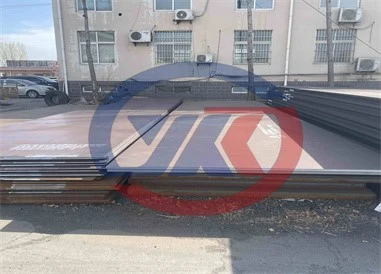
Choose DH36 if
Your offshore structure operates in temperate waters (e.g., Gulf of Mexico, Southeast Asia, Mediterranean).
The minimum design temperature is above -20°C.
Classification society requires Grade D (common for floating production units in non-arctic zones).
You want faster delivery and slightly lower budget.
Typical applications:
Ship hulls (cargo, tankers, bulk carriers)
Upper deck structures of offshore platforms
Jack-up legs in mild climates.
Choose EH36 if
Your project is in arctic or sub-arctic regions (North Sea, Barents Sea, Northern Canada, Sakhalin).
The steel will face low-temperature impact risks (ice impact, sudden cooling, winter storms).
Classification rules demand Grade E for certain critical components (e.g., motion-compensated crane pedestals, subsea support frames).
Long-term reliability below -20°C is non-negotiable.
Typical applications:
FPSO hulls operating in North Atlantic
Fixed platforms in the Barents Sea
Ice-strengthened vessels (Polar Class)
Deep-water mooring components.
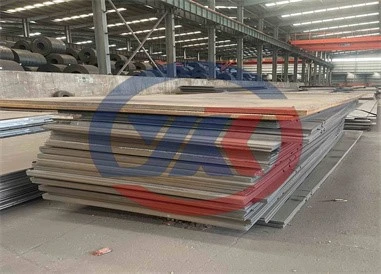

why choose us?
Standard sizes are all available in stock.
Thickness range: 6mm – 200mm
Width: up to 4,500mm
Length: up to 20,000mm
Mill certificates: EN 10204 3.1/3.2 available
one-stop solution
professional team
high quality
Choose YUXIN steel group, and what you purchase is not merely the steel plates, but also a complete warranty system and a sense of responsibility.
Our address
Tianjin, China
Phone Number
(86)-15937221771(WeChat)
(86)-15837212056(WhatsApp)
info@chinasteelcompany.com

FAQ

01.Can I use DH36 instead of EH36 to save cost on an offshore project?
Only if your project's minimum design temperature is -20°C or higher.
DH36 and EH36 have the same yield strength (355 MPa), but EH36 is impact-tested at -40°C, while DH36 is only tested at -20°C. If your offshore structure will operate in arctic or sub-arctic regions (North Sea, Barents Sea, Northern Canada), substituting DH36 for EH36 risks brittle fracture – a safety failure that will not pass classification society inspection (ABS, DNV, LR).
Verdict: Never swap EH36 for DH36 in low-temperature environments just to save 5–10% on material cost. The liability is too high.
02.What are the welding differences between EH36 and DH36 steel plates?
Both grades have good weldability using common processes (SMAW, SAW, GMAW, FCAW). However:
DH36 can be welded with no preheat or minimal preheat (≥5°C) in most shop conditions.
EH36 requires preheat of 15–25°C minimum (sometimes higher for thick plates >50mm) to prevent hydrogen-induced cracking, especially in cold ambient temperatures.
Use low-hydrogen electrodes (E7016 or E7018 class) for both.
For EH36, strictly control interpass temperature (≤200°C) and avoid rapid cooling.
Always follow the welding procedure specification (WPS) approved by your classification society. A generic WPS for DH36 will not automatically pass for EH36.
03.Are EH36 and DH36 available with the same classification society certifications?
Yes – both grades are offered by ABS, DNV, LR, BV, NK, RINA, and CCS.
However, the certificate wording must match the exact grade and impact temperature.
A DH36 mill certificate will state: *"Impact test: -20°C"*
An EH36 mill certificate will state: *"Impact test: -40°C"*
Critical warning: Do not accept a certificate that says "DH36/EH36" unless it clearly specifies which impact temperature was actually tested. For offshore projects, always request EN 10204 Type 3.2 certification (inspected by a third-party surveyor from the classification society).
04.Which shipbuilding steel plate is more available in stock – DH36 or EH36?
DH36 is significantly more common in global inventory.
Most large steel mills and service centers stock DH36 in thicknesses 6mm–150mm as their default high-strength marine plate.
EH36 is typically made-to-order or held in limited quantities by specialized offshore suppliers, especially for thickness >80mm or width >3,500mm.

China one-stop steel processing procurement
Through years of understanding and precipitation of steel, Yuxin Group has now become a mature steel processing and manufacturer, providing various products for many construction companies and steel structure companies around the world. Thanks to Yuxin Group's professionalism and integrity, it has become a world-renowned enterprise.


