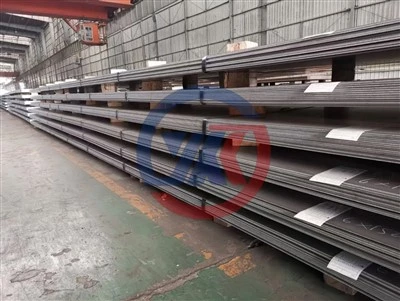
In industries with extremely demanding requirements for steel plate performance, such as petrochemicals and boiler manufacturing, ASTM A516 GR 70 steel plate is a widely used material. As a carbon steel plate specifically designed for low-to-medium temperature pressure vessels under American standards, it maintains stable performance under high-pressure and low-temperature conditions. The reason for these properties lies in its precisely balanced chemical composition. Many customers ask during procurement: "What exactly is the composition of ASTM A516 GR 70? Why is it suitable for so many demanding scenarios?" Yuxin Steel analyzes the chemical composition of this grade to help you better understand the product and select the appropriate steel plate for your project.
The composition of ASTM A516 GR 70 steel plate strictly adheres to the American ASTM/A516M standard. Its core characteristics are: primarily low carbon content, precise control of impurities, and rationally added alloying elements. This ensures strength while maintaining practicality.
Main Ingredients
Carbon (C)
Carbon (C) is the most fundamental core element, with a content ≤0.27%. Carbon functions like rebar in construction-the right amount makes steel plates stronger and enhances tensile strength. This is also key to ASTM A516 GR 70 achieving a tensile strength of 485-620 MPa. Does more carbon mean better? Not necessarily.
Excessive carbon content renders steel plates brittle and rigid, making them prone to cracking during welding and unsuitable for pressure vessel applications. Conversely, too little carbon results in insufficient strength to withstand high-pressure conditions. Therefore, a carbon content below 0.27% represents the optimal balance.
Manganese (Mn)
Manganese (Mn) is the second most critical element after carbon, with a content range of 0.85%-1.20%. Its primary function is to compensate for the strength deficiency caused by low carbon content while significantly enhancing the steel plate's toughness and impact resistance. It refines the internal grain structure of the steel plate, preventing brittle fracture even in low-temperature environments.
ASTM A516 GR 70 is commonly used in pressure vessels operating at -29°C or lower temperatures, such as liquefied gas storage tanks and cryogenic separators. Incorporating manganese-containing steel plates into these vessels effectively prevents fracture accidents at low temperatures, ensuring operational safety. Additionally, manganese improves the steel plate's workability, making it easier to cut and bend to meet diverse manufacturing requirements for different equipment.
Silicon (Si)
Silicon (Si) content ranges between 0.15% and 0.40%. Adding silicon during steelmaking effectively removes oxygen from molten steel, reducing internal porosity and impurities while enhancing the plate's purity and density. This is a key factor enabling steel plates to withstand high pressure and resist leakage. Additionally, silicon helps enhance the plate's strength and hardness. When combined with manganese and carbon, it further optimizes the plate's overall mechanical properties. This design enables the steel plate to withstand high pressure while accommodating complex processing techniques, preventing performance defects caused by excessive impurities.
Phosphorus (P) and Sulfur (S)
Phosphorus (P) and sulfur (S) are harmful impurities, and A516 GR 70 strictly controls the content of these two elements. Excessive phosphorus content can cause "cold brittleness" in steel plates, making them prone to sudden fracture without warning in low-temperature environments. Excessive sulfur content induces "hot brittleness," making the steel prone to cracking during welding or heat treatment, significantly compromising its service life and safety. Consequently, phosphorus and sulfur content serve as critical indicators distinguishing high-quality steel plates from inferior ones.
Summary
Finally, there is one more critical indicator-carbon equivalent (CEV), which must be ≤0.45%. Carbon equivalent serves as the core metric for assessing steel plate weldability, comprehensively reflecting the impact of various elements on weldability. A CEV of ≤0.45% signifies that ASTM A516 GR 70 possesses outstanding weldability, enabling high-quality welds without complex preheating processes.
In summary, the composition of A516 GR 70 is engineered to meet the demands of medium-to-low temperature and high-pressure applications while delivering excellent machinability and weldability. This precise chemical balance makes it the material of choice for petrochemical, nuclear power, boiler, and other industries, safeguarding industrial production safety and stability.
Should you have any questions regarding the composition or properties of ASTM A516 GR 70 steel plates during procurement, or require assistance in selecting the appropriate specifications for your specific operating conditions, please feel free to contact us. Our professional team will provide you with personalized solutions, ensuring your procurement process is worry-free and your usage is worry-free.