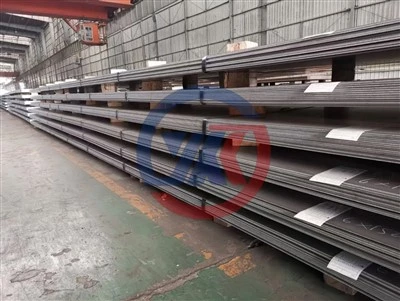
Both A516 GR70 and A516 GR70N are specialized steel plates for medium- and low-temperature pressure vessels under the ASTM/ASME standards system. They share identical core compositions and fundamental strength specifications, but the "N" suffix denotes a normalized heat treatment process, resulting in differences in microstructure, mechanical properties, and application scenarios. The distinction lies in their heat treatment conditions, which in turn creates a tiered performance and applicability spectrum, precisely matching diverse industrial requirements. As a professional steel plate supplier, Yuxin Steel provides a detailed explanation of their differences in this article.
I. Core Definitions and Heat Treatment Process Differences
A516 GR70 is the base grade, primarily delivered in hot-rolled or stress-relieved conditions without mandatory normalizing requirements. Its production process involves smelting, refining, continuous casting, and rolling, allowing direct shipment in the hot-rolled state. For thicknesses ≤40mm, no additional heat treatment is needed, with fundamental mechanical properties ensured solely through rolling.
The "N" in A516 GR70N explicitly denotes "normalized treatment," classifying it as an additional heat-treated strengthening grade. It requires heating to 920-980°C followed by air cooling. Precise temperature control and regulated cooling rates optimize microstructural reconstruction.
Note that for plate thicknesses exceeding 40mm, A516 GR70 typically defaults to normalized delivery. Conversely, A516 GR70N mandates normalized treatment regardless of thickness, with explicit certification in the quality guarantee document.

II. Differences in Microstructure and Mechanical Properties
The core value of the normalizing process lies in optimizing microstructure and properties, which also represents the most critical distinction between the two.
The as-rolled microstructure of A516 GR70 primarily consists of ferrite and pearlite, featuring relatively coarse and unevenly distributed grains. Residual rolling stresses remain internally, resulting in poor low-temperature toughness and microstructural stability. At -29°C, Charpy V-notch impact energy typically only meets basic requirements.
After normalizing treatment, A516 GR70N exhibits significantly refined grain structure and more uniform carbide distribution. This effectively eliminates internal stresses and reduces material hardness (≤200 HB), substantially enhancing overall performance. Its low-temperature toughness is outstanding, with impact energy consistently exceeding 27 J at -46°C. Resistance to hydrogen-induced cracking (HIC) and sulfide stress corrosion (SSC) is also enhanced due to improved microstructural purity. Fatigue strength increases by approximately 15% compared to A516 GR70, offering greater resistance to alternating loads and low-temperature brittle fracture risks.
While both grades share consistent base strength metrics (tensile strength 485-620 MPa, yield strength ≥260 MPa), A516 GR70N offers superior performance stability and batch consistency, with significantly reduced variation compared to hot-rolled A516 GR70.
III. Differences in Application Scenarios and Suitable Operating Conditions
A516 GR70 is suitable for normal or medium temperatures, low corrosion environments, and applications with low requirements for low-temperature toughness. Examples include standard petrochemical storage tanks, atmospheric heat exchangers, and conventional onshore pressure pipelines. It can be safely used within the temperature range of room temperature to 100°C and offers high cost-effectiveness.
A516 GR70N is specifically engineered for low-temperature, high-pressure, and corrosive environments, making it the preferred choice for extreme conditions. In petrochemical applications, it is suitable for liquefied petroleum gas (LPG) storage tanks (-40°C operating conditions) and hydrogen sulfide (H₂S)-containing desulfurization towers. Within the power generation sector, it is used to manufacture boiler drums and auxiliary equipment for nuclear power plants.

IV. Quality Control and Cost Differences
A516 GR70N undergoes stricter quality control standards. Each sheet must pass ultrasonic testing before shipment (sheets thicker than 20mm require Grade I or higher), with mandatory testing for low-temperature impact performance and microstructural uniformity. A516 GR70 only requires basic flaw detection and mechanical property testing.
A516GR70N commands a 10%-20% premium over A516GR70 due to additional normalizing heat treatment and elevated inspection standards. However, it retains carbon steel's cost advantage over stainless steel or nickel-based alloys (only 1/3 to 1/2 the cost of 304 stainless steel). In projects demanding extremely high safety factors, the performance premium of A516 GR70N effectively reduces equipment failure risks, thereby delivering long-term economic value.
V. Summary
The two grades essentially represent a base model and an enhanced variant, with their core distinction stemming from the performance upgrades achieved through normalizing treatment. Selection must be closely aligned with operational requirements.
For standard pressure vessels operating at ambient temperatures, low pressures, and without corrosion risks, A516 GR70 meets requirements while balancing cost-effectiveness and practicality.
For applications involving cryogenic temperatures, high pressures, corrosive media, or extreme environments, A516 GR70N must be selected. Its optimized microstructure and properties ensure long-term equipment safety.
If you're unsure about selecting the appropriate steel plate, please share your requirements. We provide professional customized solutions.