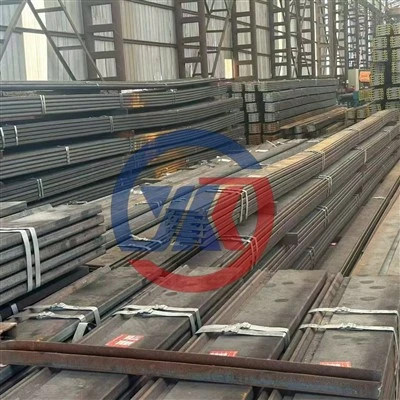
In the field of pressure vessel and boiler manufacturing, A516 Grade 70 is a widely adopted medium-carbon manganese steel plate. During material selection and design processes, yield strength stands as one of the most critical parameters engineers prioritize. So, what exactly is the yield strength of A516 GR 70? This article provides a detailed explanation of the yield strength of A516 Grade 70 to help you better understand this steel plate. If you need to purchase this steel plate, please click the button below to contact us.
I. Standard Yield Strength of A516 GR 70
According to ASTM A516 / A516M standards: The minimum yield strength of ASTM A516 GR 70 is 260 MPa (38 ksi).
This represents a guaranteed minimum value; the yield strength of actual supplied steel plates typically exceeds 260 MPa.
However, in design calculations and specification selection, 260 MPa is used as the reference value.
II. Correspondence with Tensile Strength
The mechanical properties of A516 GR 70 are not determined solely by yield strength; tensile strength must also be considered.
|
Project |
Value |
|
Yield Strength |
≥ 260 MPa |
|
Tensile Strength |
485–620 MPa |
|
Elongation |
≥ 21% (relative to thickness) |
This combination demonstrates:
- Moderate yield strength
- Wide tensile strength range
- Good plasticity and toughness
This is one of the core reasons why A516 GR 70 is suitable for pressure vessels.
III. Significance of Yield Strength in Pressure Vessel Design
In pressure vessel design codes such as ASME VIII and GB 150:
The allowable stress of a material is typically directly related to its yield strength.
Higher yield strength permits thinner wall thicknesses under identical operating conditions.
However, it is important to note:
A higher yield strength does not necessarily mean the material is more suitable for pressure vessels.
Pressure vessels emphasize comprehensive properties, including:
- Toughness
- Weldability
- Resistance to brittle fracture

2. A516 GR 70's yield strength is "just right"

Compared to some high-strength steels, A516 GR 70 does not pursue extremely high yield strength. Instead, it maintains a safe, stable, and weldable range:
- Less prone to weld cracking
- Manufacturing-friendly
- Safer for low-temperature conditions
This is also a key reason for its suitability in medium-to-low temperature pressure vessel applications.
IV. Relationship Between Yield Strength and Plate Thickness
In the ASTM A516 standard:
Yield strength does not vary by thickness classification.
Regardless of whether it is thin plate or thick plate, the minimum yield strength requirement is 260 MPa.
However, in actual production:
The actual yield strength of thick plates is typically slightly lower than that of thin plates.
This is why designs must strictly adhere to the minimum values specified in the standard.
V. Effect of Heat Treatment Condition on Yield Strength
Common supply conditions for A516 GR 70 include:
As-rolled condition
Normalized condition
Generally:
Normalized plates exhibit more uniform microstructure
More stable yield strength
Better impact toughness assurance
In applications requiring low-temperature performance or enhanced toughness, normalized A516 GR 70 is often the preferred choice in engineering practice.
VI. Summary
The minimum yield strength of ASTM A516 GR 70 is 260 MPa, a standard value that must be adhered to during pressure vessel design and material selection.
Understanding the yield strength of A516 GR 70 not only assists engineers in precise material selection and design optimization but also ensures the safe operation of pressure vessels, preventing accidents caused by substandard material performance.
Yuxin Steel offers a diverse range of plate grades. If you're uncertain about selecting the appropriate steel plate, please share your requirements. We provide professional customized solutions.