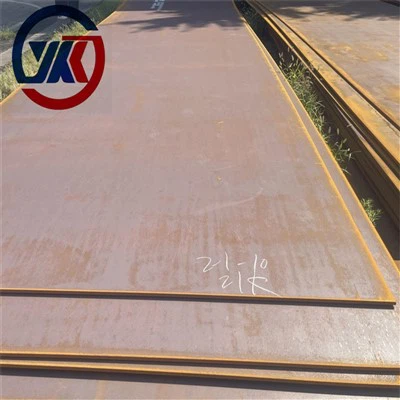
Hey there! As a supplier of A516GR70 for Pressure Vessels, I often get asked about the creep resistance of this material. So, I thought I'd take a moment to break it down and share some insights with you.
What is Creep Resistance?
Before we dive into the specifics of A516GR70, let's quickly go over what creep resistance actually means. Creep is the gradual deformation of a material over time under a constant load and at elevated temperatures. It's like how a piece of taffy slowly stretches when you hold it for a while. Creep resistance, then, is a material's ability to resist this kind of deformation.
Why is Creep Resistance Important for Pressure Vessels?
Pressure vessels are used in a wide range of industries, from oil and gas to power generation. They're designed to hold fluids or gases under high pressure, and they often operate at elevated temperatures. In these conditions, creep can be a major concern. If a pressure vessel starts to deform due to creep, it can compromise its integrity and lead to leaks or even catastrophic failures. That's why having a material with good creep resistance is crucial for ensuring the safety and reliability of pressure vessels.
The Creep Resistance of A516GR70
A516GR70 is a popular choice for pressure vessel applications, and one of the reasons for this is its excellent creep resistance. This material is a carbon steel that's specifically designed for use in welded pressure vessels. It has a relatively high carbon content, which gives it good strength and toughness. But it also contains other elements, like manganese and silicon, which help to improve its creep resistance.
At moderate temperatures, A516GR70 exhibits very little creep. This means that it can maintain its shape and integrity over long periods of time, even under high pressure. However, as the temperature increases, the creep rate of A516GR70 will also increase. That's why it's important to use this material within its recommended temperature range.
Factors Affecting the Creep Resistance of A516GR70
There are several factors that can affect the creep resistance of A516GR70. One of the most important is temperature. As I mentioned earlier, the higher the temperature, the faster the creep rate. So, if you're using A516GR70 in a high-temperature application, you'll need to take extra precautions to ensure its long-term performance.
Another factor is the stress level. The higher the stress on the material, the more likely it is to creep. That's why it's important to design pressure vessels to operate within the allowable stress limits for A516GR70.
The composition of the material also plays a role in its creep resistance. A516GR70 is a carefully formulated alloy, and any variations in its composition can affect its properties. That's why it's important to source A516GR70 from a reputable supplier who can ensure the quality and consistency of the material.
Comparing A516GR70 with Other Materials
When it comes to pressure vessel applications, there are several other materials that are commonly used. One of these is ASTM A203 Grade A(A203GRA) Pressure Vessel And Boiler Steel Plate. While A203GRA is also a good choice for pressure vessels, it has different properties than A516GR70. In general, A516GR70 has better creep resistance than A203GRA, especially at moderate temperatures.
Another material that's often compared to A516GR70 is A516GR60. You can check out A516GR70 Vs A516GR60 Comparison for a detailed look at the differences between these two materials. In terms of creep resistance, A516GR70 is generally considered to be superior to A516GR60. This is because A516GR70 has a higher carbon content and a more optimized alloy composition.
Applications of A516GR70 in Pressure Vessels
A516GR70 is used in a wide variety of pressure vessel applications. Some of the most common include boilers, storage tanks, and heat exchangers. In boilers, A516GR70 is used to construct the pressure vessel that holds the water and steam. Its good creep resistance ensures that the boiler can operate safely and efficiently over long periods of time.


Storage tanks made from A516GR70 are used to store a variety of fluids and gases, including oil, gas, and chemicals. The material's high strength and good creep resistance make it suitable for these applications, where the tank needs to withstand high pressure and long-term exposure to the stored substance.
Heat exchangers are another important application for A516GR70. These devices are used to transfer heat between two fluids, and they often operate at elevated temperatures and pressures. A516GR70's ability to resist creep makes it an ideal choice for constructing the pressure vessel and other components of the heat exchanger.
Our A516GR70 Products
As a supplier of A516GR70 for Pressure Vessels, we offer a wide range of products to meet the needs of our customers. Our ASTM A516 Gr70 Boiler Plate is made from high-quality A516GR70 material and is available in a variety of thicknesses and sizes. We also offer A516Gr70 Boiler Steel Plate and A516 Gr70 Steel Metal Sheet For Boiler, which are suitable for a variety of boiler and pressure vessel applications.
All of our products are manufactured to the highest quality standards and are tested to ensure their performance and reliability. We work closely with our customers to understand their specific needs and to provide them with the best possible solutions.
Conclusion
In conclusion, the creep resistance of A516GR70 is one of its key advantages for pressure vessel applications. This material's ability to resist deformation under high pressure and elevated temperatures makes it a reliable and safe choice for a wide range of industries. If you're in the market for A516GR70 for Pressure Vessels, we'd love to hear from you. Contact us today to discuss your requirements and to learn more about our products and services.
References
- ASME Boiler and Pressure Vessel Code
- ASTM International Standards for Steel Plates for Pressure Vessels
- Technical literature on A516GR70 and related materials