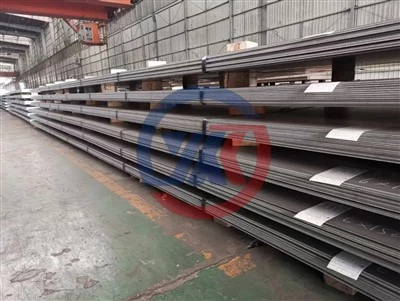
Understanding AH36 Shipbuilding Steel Chemical Composition: A Complete Guide
When sourcing steel for marine construction, understanding the AH36 shipbuilding steel chemical composition is critical. This high-strength structural steel is the backbone of modern shipbuilding, used extensively in hull construction, offshore drilling platforms, and other marine applications. This guide breaks down its chemical makeup, mechanical properties, and why these specifications matter for your projects.
What is AH36 Shipbuilding Steel?
AH36 is a high-strength structural steel grade certified by the American Bureau of Shipping (ABS) and defined under the ASTM A131 / A131M standard . It belongs to the "higher strength" category of shipbuilding steels, with a specified minimum yield strength of 51 ksi (approximately 355 MPa) . The "A" designation indicates it is suitable for impact testing at 0°C (32°F), distinguishing it from grades like DH36 (tested at -20°C) and EH36 (tested at -40°C) .
AH36 offers an optimal balance of strength, weldability, and toughness, making it the material of choice for vessels weighing over 10,000 tons and demanding marine environments.
Detailed AH36 Chemical Composition
The AH36 chemical composition is carefully controlled to achieve the required mechanical properties while ensuring good weldability and corrosion resistance. The following table outlines the typical element limits according to industry standards:
| Element | Composition (Max %) | Role in Steel |
|---|---|---|
| Carbon (C) | ≤ 0.18% | Increases strength and hardness, but too much reduces weldability. |
| Silicon (Si) | 0.10% – 0.50% | Acts as a deoxidizer and adds strength. |
| Manganese (Mn) | 0.90% – 1.60% | Improves strength, hardness, and wear resistance; a key strengthening element. |
| Phosphorus (P) | ≤ 0.035% | Controlled as an impurity to prevent brittleness. |
| Sulfur (S) | ≤ 0.035% | Controlled as an impurity to prevent hot cracking during welding. |
| Aluminum (Al) | 0.015% – 0.08% | Used for grain refinement and deoxidation. |
| Niobium (Nb) | 0.02% – 0.05% | Provides grain refinement and precipitation hardening for higher strength. |
| Vanadium (V) | 0.05% – 0.10% | Contributes to strength through grain refinement and precipitation strengthening. |
| Titanium (Ti) | ≤ 0.02% | Aids in grain refinement and improves toughness. |
| Copper (Cu) | ≤ 0.35% | Enhances corrosion resistance in marine environments. |
| Nickel (Ni) | ≤ 0.40% | Improves toughness, particularly at low temperatures. |
| Chromium (Cr) | ≤ 0.20% | Increases hardenability and corrosion resistance. |
| Molybdenum (Mo) | ≤ 0.08% | Boosts strength and high-temperature stability. |
Mechanical Properties Linked to Composition
| Property | Value | Significance |
|---|---|---|
| Yield Strength | 355 MPa (51 ksi) minimum | The stress at which the steel begins to deform permanently; ensures hull integrity. |
| Tensile Strength | 490 – 620 MPa (71 – 90 ksi) | The maximum stress the steel can withstand before fracture. |
| Elongation | ≥ 21% – 22% | A measure of ductility; the steel can stretch significantly before breaking, which is vital for absorbing energy and preventing brittle failure |

Conclusion
The AH36 shipbuilding steel chemical composition is a meticulously balanced alloy designed for the demanding conditions of marine service. By carefully controlling elements like Carbon, Manganese, and micro-alloys (Nb, V, Ti), manufacturers produce steel that is strong, tough, weldable, and resistant to the corrosive marine environment. Understanding these specifications is essential for engineers, procurement specialists, and fabricators to ensure the safety, durability, and performance of their marine structures.
one-stop solution
professional team
high quality
Choose YUXIN steel group, and what you purchase is not merely the steel plates, but also a complete warranty system and a sense of responsibility.
Our address
Tianjin, China
Phone Number
(86)-15937221771(WeChat)
(86)-15837212056(WhatsApp)
info@chinasteelcompany.com

FAQ

01.Does the AH36 chemical composition affect its weldability, and what precautions should be taken?
Yes, significantly. The weldability of AH36 steel is primarily determined by its Carbon Equivalent (CEV) value. As per the chemical composition limits, the CEV for AH36 is strictly controlled to ≤ 0.38% for plates under 50mm. This low CEV ensures good weldability without requiring extensive preheating under normal conditions.
However, because AH36 contains micro-alloying elements like Niobium (Nb) and Vanadium (V) for grain refinement, these elements can increase hardenability. For thicker plates (over 50mm) or in low ambient temperatures, it is recommended to:
Maintain a minimum preheat temperature of 50°C - 100°C to prevent hydrogen-induced cold cracking.
Use low-hydrogen welding consumables.
Control the interpass temperature to avoid excessive grain growth in the Heat-Affected Zone (HAZ).
Following these precautions ensures the welded joint retains the same mechanical properties as the base plate.
02.What is the difference between AH36 and DH36 steel in terms of chemical composition?
From a purely chemical composition standpoint, the allowable limits for AH36 and DH36 are nearly identical. Both grades share the same restrictions on elements like Carbon (≤0.18%), Manganese (0.90-1.60%), Silicon, Phosphorus, and Sulfur, as defined under the ASTM A131 standard.
The critical difference lies not in the chemistry but in the impact toughness testing temperature. The "A" in AH36 signifies it is impact tested at 0°C (32°F), while the "D" in DH36 requires impact testing at a much lower temperature of -20°C (-4°F). To achieve this superior low-temperature toughness, steel mills may slightly adjust grain-refining elements (like Niobium and Vanadium) and employ stricter thermomechanical rolling processes, but the overall chemical composition limits remain within the same range. Therefore, DH36 is often preferred for vessels operating in colder climates.
03.Why is the Manganese (Mn) content in AH36 steel kept between 0.90% and 1.60%?
Manganese is one of the most critical alloying elements in AH36 steel, and its range (0.90% - 1.60%) is carefully balanced for several reasons:
Strengthening Effect: Manganese acts as a solid-solution strengthener. It increases the tensile and yield strength of the steel without significantly sacrificing ductility, helping AH36 achieve its minimum 355 MPa yield strength.
Deoxidizer: It serves as a potent deoxidizer, removing excess oxygen from the molten steel to prevent porosity during solidification.
Sulfur Neutralization: Manganese combines with Sulfur (an impurity) to form manganese sulfides (MnS), which are more ductile than iron sulfides. This prevents "hot shortness" (cracking during hot rolling) and improves toughness.
Grain Refinement: It lowers the transformation temperature of austenite, promoting a finer ferrite grain structure.
Keeping it below 1.60% ensures the steel retains excellent weldability and does not become overly hard or brittle.
04.Can I substitute A36 structural steel for AH36 shipbuilding steel?
No, absolutely not. While the names sound similar, they are fundamentally different grades with distinct applications. Here is why substitution is unsafe and non-compliant:
Yield Strength: Regular A36 structural steel has a minimum yield strength of 250 MPa (36 ksi). AH36 has a minimum yield strength of 355 MPa (51 ksi), a significant 40% increase in strength.
Impact Toughness: A36 has no mandatory Charpy V-notch impact testing requirements for shipbuilding. AH36 is strictly required to absorb a minimum of 34 Joules at 0°C, ensuring it won't fracture brittlely in rough seas.
Chemical Composition Control: AH36 has much tighter controls on micro-alloying elements (Nb, V, Ti) and lower Carbon equivalents to ensure superior weldability and corrosion resistance for marine environments.
Classification Society Certification: AH36 must come with a mill certificate from classification societies like ABS, DNV, or LR. Using uncertified A36 in a hull structure would violate international maritime safety regulations and void vessel insurance. Always use certified AH36 for marine applications.

China one-stop steel processing procurement
Through years of understanding and precipitation of steel, Yuxin Group has now become a mature steel processing and manufacturer, providing various products for many construction companies and steel structure companies around the world. Thanks to Yuxin Group's professionalism and integrity, it has become a world-renowned enterprise.