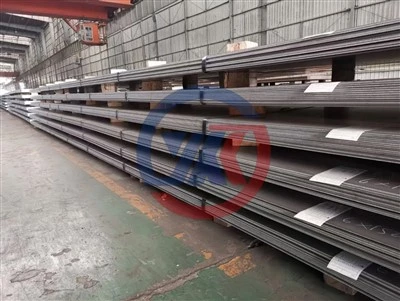
What is ABS AH36 Steel Specification?
If you work in shipbuilding or marine engineering, you've likely come across the term "ABS AH36." It's a common specification for a reason: it's a high-strength steel that forms the backbone of modern ship hulls and offshore structures. This guide breaks down the ABS AH36 steel specification-what it means, its properties, and why it's so widely used.
What Does "ABS AH36" Mean?
Let's decode the name piece by piece:
ABS stands for the American Bureau of Shipping, a leading international classification society. This certification means the steel has been manufactured, tested, and approved according to their rigorous rules for use in marine environments.
AH36 is the grade designation. The "A" indicates that this steel is impact-tested at 0°C (32°F) . The "H" stands for High Tensile Strength, and "36" refers to its minimum yield strength of 355 MPa (51,000 psi) . This makes it significantly stronger than standard mild steel used in shipbuilding, like Grade A.
Key Specifications: Chemistry and Mechanical Properties
The ABS AH36 specification mandates strict limits on both chemical composition and mechanical performance to ensure reliability.
Chemical Composition
The controlled chemical composition of AH36 ensures it has good weldability and strength. Below are the key element requirements according to ABS rules and industry data:
| Element | Max % (Typical) | Role in the Steel |
|---|---|---|
| Carbon (C) | 0.18 | Provides strength; limited to maintain weldability. |
| Manganese (Mn) | 0.90 - 1.60 | Increases strength and hardenability. |
| Silicon (Si) | 0.10 - 0.50 | Acts as a deoxidizer in the steelmaking process. |
| Phosphorus (P) | 0.035 | Controlled as a harmful impurity that can reduce toughness. |
| Sulfur (S) | 0.035 | Controlled as a harmful impurity that can reduce ductility. |
| Aluminum (Al) | 0.015 (min) | Used for grain refinement. |
| Niobium (Nb) | 0.02 - 0.05 | Contributes to grain refinement and precipitation hardening. |
| Vanadium (V) | 0.05 - 0.10 | Adds strength through precipitation hardening. |
Carbon Equivalent (CEV) is also critical. It's a formula used to estimate the steel's hardenability and weldability. For AH36, the CEV is typically controlled to a maximum of 0.38% for thinner plates to prevent issues like cold cracking during welding.
Mechanical Properties
The mechanical properties of AH36 are where its high-strength designation truly shines.
| Property | Value (Metric) | Value (Imperial) |
|---|---|---|
| Yield Strength (Min) | 355 MPa | 51,000 psi |
| Tensile Strength | 490 - 620 MPa | 71 - 90 ksi |
| Elongation (Min) | 21% | 21% |
Impact Toughness: The Charpy V-Notch Test
A defining feature of AH36 is its guaranteed toughness. The specification requires passing the Charpy V-notch impact test at 0°C (32°F). This proves the steel can absorb significant energy without fracturing, which is crucial in the cold, harsh marine environment.
The required impact energy depends on the steel's thickness:
| Thickness Range (mm) | Test Temp. | Min. Avg. Energy (Longitudinal) |
|---|---|---|
| ≤ 50 mm | 0°C | 34 J |
| > 50 - 70 mm | 0°C | 41 J |
| > 70 - 100 mm | 0°C | 50 J |
AH36 vs. DH36 and EH36
You'll often hear AH36 mentioned alongside DH36 and EH36. They have identical strength properties (355 MPa yield, 490-620 MPa tensile), but the key difference is their impact test temperature.
AH36: Impact tested at 0°C (32°F) - suitable for most general-purpose ships.
DH36: Impact tested at -20°C (-4°F) - for vessels operating in colder environments.
EH36: Impact tested at -40°C (-40°F) - for Arctic or extremely cold weather conditions.
Choosing the right grade is a critical design decision based on the vessel's operational route and temperature exposure.
Global Equivalents
Because shipbuilding is a global industry, the ABS AH36 specification has equivalents under other classification societies:
DNV: NV A36
LR (Lloyd's Register): LR/AH36
BV (Bureau Veritas): BV/AH36
CCS (China Classification Society): CCS/A36
NK (Nippon Kaiji Kyokai): K A36
RINA: RI/A36
Dimensions and Supply Forms
AH36 steel is primarily supplied as plates, but also as structural shapes like angles and bulb flats.
Plates: Typically available in thicknesses from 4mm to over 300mm, widths from 1,200mm to 4,000mm, and lengths from 3,000mm to 12,000mm.
Delivery Condition: Can be supplied in various conditions, including normalized, thermo-mechanically controlled processed (TMCP), or as-rolled, depending on the thickness and required properties.

Conclusion
ABS AH36 is a highly specified high-strength steel that is fundamental to modern shipbuilding. Its combination of certified quality (ABS), high yield strength (355 MPa), and excellent impact toughness (at 0°C) makes it the go-to material for constructing the hulls, decks, and structural components of bulk carriers, container ships, and offshore platforms. Understanding its specification is key for anyone involved in the design, construction, or procurement of marine structures.
one-stop solution
professional team
high quality
Choose YUXIN steel group, and what you purchase is not merely the steel plates, but also a complete warranty system and a sense of responsibility.
Our address
Tianjin, China
Phone Number
(86)-15937221771(WeChat)
(86)-15837212056(WhatsApp)
info@chinasteelcompany.com

FAQ

01.What is the difference between ABS AH36 and mild steel?
02.Can ABS AH36 steel be welded without preheating?
03.What is the maximum thickness available for ABS AH36 plates?
04.Do I need ABS certification for every AH36 steel plate?

China one-stop steel processing procurement
Through years of understanding and precipitation of steel, Yuxin Group has now become a mature steel processing and manufacturer, providing various products for many construction companies and steel structure companies around the world. Thanks to Yuxin Group's professionalism and integrity, it has become a world-renowned enterprise.