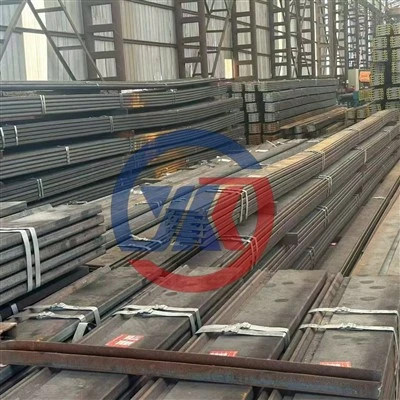
What is ABS Grade A? A Complete Guide to Marine Steel Plate
If you work in shipbuilding, offshore engineering, or marine repair, you've likely encountered the term ABS Grade A. But what exactly does it mean? And why is it so critical for vessel safety and compliance?
This guide provides a deep technical dive into ABS Grade A steel - from its mechanical properties and chemical composition to its real-world applications and how it compares to other marine grades.
What is ABS Grade A?
ABS Grade A is a general strength structural steel plate certified by the American Bureau of Shipping (ABS) for use in shipbuilding and marine structures.
In simple terms: It's a low-carbon steel plate that has passed rigorous third-party inspection by ABS to ensure its chemical and mechanical properties meet international marine safety standards.
The "A" indicates a specific sub-grade within the general strength category, characterized by guaranteed chemical composition and specified impact toughness requirements.
✅ Key takeaway: ABS Grade A is the baseline certified steel for non-critical hull structures.
Why ABS Certification Matters
Founded in 1862, the American Bureau of Shipping (ABS) is one of the world's leading classification societies. When a steel plate carries ABS certification, it guarantees:
| Feature | What It Means |
|---|---|
| Standardization | Minimum yield and tensile strength are guaranteed. |
| Traceability | Every plate comes with a Mill Test Report (MTR). |
| Safety | The material is approved for ship hulls, barges, and offshore platforms. |
| Weldability | Controlled carbon content ensures reliable welding. |
Without ABS certification, steel cannot be used in ABS-classed vessels.
ABS Grade A: Key Technical Specifications
1. Mechanical Properties (General Strength)
| Property | Value (Imperial) | Value (Metric) |
|---|---|---|
| Yield Strength (min) | 34 ksi | 235 MPa |
| Tensile Strength | 58 – 75 ksi | 400 – 520 MPa |
| Elongation (2-inch gauge) | 22% (min) | 22% (min) |
📌 Note: For plates thicker than 1 inch (25.4 mm), the minimum yield strength requirement may be reduced to 32 ksi (220 MPa).
2. Chemical Composition (Typical Limits)
| Element | Requirement |
|---|---|
| Carbon (C) | ≤ 0.21% |
| Manganese (Mn) | ≥ 2.5 × C% |
| Silicon (Si) | 0.10 – 0.35% |
| Phosphorus (P) | ≤ 0.035% |
| Sulfur (S) | ≤ 0.035% |
⚠️ Always refer to the latest ABS Rules or the supplier's Mill Test Report for exact values, as limits may vary slightly by thickness.
3. Impact Toughness (Charpy V-Notch Test)
This is the most important differentiator between ABS Grade A and other general strength grades (B, D, E).
| Grade | Test Temperature | Typical Absorbed Energy |
|---|---|---|
| Grade A | Room temperature (≈20°C / 68°F) | ≥ 20 J |
| Grade B | 0°C (32°F) | ≥ 20 J |
| Grade D | -20°C (-4°F) | ≥ 27 J |
| Grade E | -40°C (-40°F) | ≥ 27 J |
Why this matters: Grade A is not suitable for low-temperature or polar service. For cold environments, choose Grade D or E.
ABS Grade A vs. Other Marine Steel Grades
To help you make the right material selection, here's a direct comparison:
| Comparison Point | ABS Grade A | ABS Grade AH36 |
|---|---|---|
| Strength Level | General Strength | High Strength |
| Yield Strength | 235 MPa (34 ksi) | 355 MPa (51 ksi) |
| Typical Applications | Superstructures, bulwarks, light-load areas | Main hull, deck, side shell, heavy-load areas |
| Cost | Lower | Higher |
| Preheating for Welding | Usually not required | Sometimes required (higher carbon equivalent) |
| Low-Temperature Use | Not recommended | Yes, with specified impact grades |
Quick selection guide:
✅ Choose Grade A for inland vessels, small barges, or non-critical structural parts.
✅ Choose AH36 / DH36 for ocean-going vessels, cargo holds, or high-stress areas.
Common Applications of ABS Grade A
Thanks to its excellent weldability, ductility, and cost-effectiveness, ABS Grade A is widely used in:
Ship hulls (bottom and side shells – low-stress zones)
Bulwarks (protective rails along deck edges)
Coamings (hatch openings for cargo holds)
Barge structures (inland and near-coastal barges)
Offshore platform auxiliary structures
Temporary marine equipment

why choose us?
ABS Grade A may not have the high strength of AH36 or the low-temperature toughness of Grade E. But it offers something equally valuable for many projects:
✅ Proven reliability (over a century of use)
✅ Excellent weldability
✅ Affordable cost
✅ Full traceability and certification
For non-critical hull structures, barges, and inland vessels, ABS Grade A is the most cost-effective certified choice - and a material you can trust.
one-stop solution
professional team
high quality
Choose YUXIN steel group, and what you purchase is not merely the steel plates, but also a complete warranty system and a sense of responsibility.
Our address
Tianjin, China
Phone Number
(86)-15937221771(WeChat)
(86)-15837212056(WhatsApp)
info@chinasteelcompany.com

FAQ

01.Is ABS Grade A the same as ASTM A131 Grade A?
02.Can I use ABS Grade A for pressure vessels?
03.How do I verify that steel is genuine ABS Grade A?
Always request the Mill Test Report (MTR) from your supplier. The MTR must clearly state:
"ABS Certified"
Or "Meets ASTM A131/A131M Grade A"
The plate should also have visible mill stamps with grade and heat number.
04.What thicknesses are available for ABS Grade A?

China one-stop steel processing procurement
Through years of understanding and precipitation of steel, Yuxin Group has now become a mature steel processing and manufacturer, providing various products for many construction companies and steel structure companies around the world. Thanks to Yuxin Group's professionalism and integrity, it has become a world-renowned enterprise.