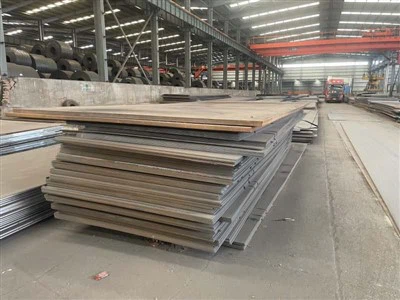
As a seasoned supplier of angle steel plates, I often receive inquiries from clients regarding how to calculate the weight of these essential construction materials. Understanding the weight of angle steel plates is crucial for various reasons, including transportation planning, structural design, and cost estimation. In this blog post, I'll share some practical methods and formulas to help you accurately calculate the weight of angle steel plates.
Understanding Angle Steel Plates
Before delving into the calculation methods, let's briefly understand what angle steel plates are. Angle steel plates, also known as angle irons, are L-shaped structural steel sections with two legs at a right angle. They are widely used in construction, machinery manufacturing, and other industries due to their high strength, durability, and versatility.
There are different grades of angle steel plates available in the market, such as Q335B Angle Steel Plate and Q235B Angle Steel Plate. Each grade has its own specific mechanical properties and chemical compositions, which may affect the weight calculation to some extent.
Factors Affecting the Weight of Angle Steel Plates
The weight of an angle steel plate is primarily determined by the following factors:
- Dimensions: The length, width, and thickness of the angle steel plate have a direct impact on its weight. Generally, the longer, wider, and thicker the plate, the heavier it will be.
- Material Density: Different grades of steel have different densities. For example, the density of carbon steel is approximately 7.85 g/cm³. The density of the steel used in the angle steel plate is a key factor in the weight calculation.
- Shape and Cross-Section: The shape and cross-sectional area of the angle steel plate also affect its weight. The standard angle steel plates have a uniform cross-section, but some special-shaped angle steel plates may have different cross-sectional areas, which need to be considered in the calculation.
Calculation Methods
There are two main methods for calculating the weight of angle steel plates: the theoretical weight calculation method and the actual measurement method.
Theoretical Weight Calculation Method
The theoretical weight calculation method is based on the standard dimensions and density of the angle steel plate. The following is the general formula for calculating the theoretical weight of an angle steel plate:
[
W = 0.00785 \times t \times (b_1 + b_2 - t) \times L
]
Where:
- (W) is the weight of the angle steel plate (kg)
- (t) is the thickness of the angle steel plate (mm)
- (b_1) and (b_2) are the widths of the two legs of the angle steel plate (mm)
- (L) is the length of the angle steel plate (m)
- 0.00785 is the density of carbon steel (g/cm³) converted to kg/mm³
Let's take an example to illustrate the use of this formula. Suppose we have a Q235B angle steel plate with a thickness of 5 mm, leg widths of 50 mm and 50 mm, and a length of 6 m. We can calculate its weight as follows:
[
\begin{align*}
W&= 0.00785 \times 5 \times (50 + 50 - 5) \times 6\
&= 0.00785 \times 5 \times 95 \times 6\
&= 0.03925 \times 95 \times 6\
&= 3.72875 \times 6\
&= 22.3725 \text{ kg}
\end{align*}
]
Actual Measurement Method
The actual measurement method involves weighing the angle steel plate using a weighing scale. This method is more accurate than the theoretical weight calculation method, especially for non-standard or special-shaped angle steel plates. However, it requires the use of a weighing scale and may not be practical in some cases.
Tips for Accurate Calculation
To ensure the accuracy of the weight calculation, here are some tips:
- Use Accurate Dimensions: When measuring the dimensions of the angle steel plate, use a precise measuring tool such as a caliper or a micrometer to obtain accurate values.
- Consider the Tolerance: In practice, the actual dimensions of the angle steel plate may deviate slightly from the standard dimensions due to manufacturing tolerances. It is advisable to consider these tolerances when calculating the weight.
- Check the Material Density: Make sure to use the correct density value for the steel used in the angle steel plate. Different grades of steel may have different densities, so it is important to refer to the material specifications.
Importance of Weight Calculation
Accurately calculating the weight of angle steel plates is of great significance in various aspects:


- Transportation Planning: Knowing the weight of the angle steel plates helps in determining the appropriate transportation method and vehicle capacity. This can prevent overloading and ensure the safety of transportation.
- Structural Design: In structural design, the weight of the angle steel plates needs to be considered to ensure the stability and safety of the structure. The accurate weight calculation can help engineers make more reasonable design decisions.
- Cost Estimation: The weight of the angle steel plates is directly related to the cost. By accurately calculating the weight, you can estimate the cost of the materials more accurately, which is beneficial for project budgeting.
Conclusion
Calculating the weight of angle steel plates is a fundamental skill for anyone involved in the construction and steel industry. By understanding the factors affecting the weight, using the appropriate calculation methods, and following the tips for accurate calculation, you can obtain reliable weight values.
As a trusted supplier of angle steel plates, we are committed to providing high-quality products and professional technical support. If you have any questions about angle steel plates or need help with weight calculation, please feel free to contact us for procurement and negotiation. We look forward to working with you to meet your project needs.
References
- Steel Construction Manual, American Institute of Steel Construction
- GB/T 706-2016, Hot-rolled Structural Steel Sections, Standardization Administration of China