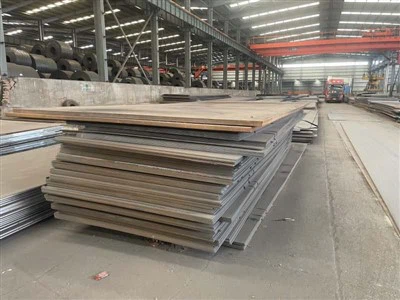
Hey there! As a supplier of A516 Gr 70 Pressure Vessel Steel Plates, I've seen firsthand how the grain size of these plates can have a huge impact on their mechanical properties. So, let's dive into what's going on with grain size and how it affects this particular type of steel.


Understanding Grain Size in A516 Gr 70 Steel
First off, what exactly do we mean by grain size? In the world of metals, grains are like tiny crystalline regions. When we talk about the grain size of A516 Gr 70 steel plates, we're referring to the average diameter of these grains. The grain size can vary significantly depending on how the steel is processed, like during rolling, heat - treating, and cooling.
There are basically two main categories of grain sizes we often deal with: fine - grained and coarse - grained. Fine - grained steel has smaller grains, while coarse - grained steel has larger ones. And trust me, these differences really matter when it comes to the steel's behavior under different conditions.
Tensile Strength and Grain Size
Tensile strength is a crucial mechanical property for pressure vessel steel plates. It's the maximum stress that a material can withstand while being stretched or pulled. When it comes to A516 Gr 70 steel, the grain size has a big influence on its tensile strength.
Generally, fine - grained A516 Gr 70 steel has higher tensile strength compared to coarse - grained steel. This is because the small grains in fine - grained steel act as barriers to the movement of dislocations. Dislocations are like defects in the crystal structure of the steel. When a force is applied to stretch the steel, these dislocations try to move. But the small grains in fine - grained steel make it difficult for the dislocations to travel, which means the steel can withstand more stress before it breaks.
For example, in a manufacturing process where high - pressure vessels are being made, using fine - grained A516 Gr 70 steel can ensure that the vessel can handle the internal pressure without failing. If we use coarse - grained steel, the dislocations can move more freely, and the steel is more likely to reach its breaking point at a lower stress level.
Ductility and Grain Size
Ductility is another important property. It's the ability of a material to deform plastically before breaking. Coarse - grained A516 Gr 70 steel generally has better ductility than fine - grained steel.
The reason behind this has to do with the way dislocations interact with the grain boundaries. In coarse - grained steel, the grain boundaries are fewer and farther apart. This allows dislocations to move more easily for longer distances without getting blocked by the boundaries. As a result, the steel can deform more before it fractures.
Let's say you're fabricating a pressure vessel that may be subjected to some form of impact or flexing. In such a case, a certain level of ductility is needed. Coarse - grained A516 Gr 70 steel might be a better choice as it can absorb more energy through plastic deformation without breaking.
Toughness and Grain Size
Toughness is the ability of a material to absorb energy and deform plastically before fracturing. Fine - grained A516 Gr 70 steel typically exhibits higher toughness, especially at low temperatures.
At low temperatures, the movement of dislocations becomes more difficult. In fine - grained steel, the large number of grain boundaries provides more paths for the energy to be dissipated. This helps prevent the rapid propagation of cracks, which could lead to sudden failure.
For pressure vessels that are going to be used in cold environments, like in some industrial processes in cold climate regions, using fine - grained A516 Gr 70 steel can significantly reduce the risk of brittle fracture. On the other hand, coarse - grained steel may become more brittle at low temperatures and is more prone to cracking under stress.
Fatigue Resistance and Grain Size
Fatigue resistance is the ability of a material to withstand repeated loading and unloading cycles without failing. Fine - grained A516 Gr 70 steel has an edge here as well.
The numerous grain boundaries in fine - grained steel stop the growth of fatigue cracks. Each time a crack approaches a grain boundary, its propagation is either slowed down or redirected. This means that fine - grained steel can endure more loading cycles before a crack becomes large enough to cause failure.
In pressure vessels that are subject to cyclic pressure changes during their operation, such as in a chemical process plant where the vessel is constantly filled and emptied, using fine - grained A516 Gr 70 steel can increase the service life of the vessel and reduce the risk of unexpected failures due to fatigue.
Why It Matters for You as a Buyer
As a buyer of A516 Gr 70 Pressure Vessel Steel Plates, understanding the effect of grain size on mechanical properties is crucial. Depending on the specific application of the pressure vessel, you need to choose the right type of steel with the appropriate grain size.
If you're building a high - pressure vessel that needs to withstand a constant high - stress environment, fine - grained steel with its higher tensile strength and fatigue resistance would be ideal. On the other hand, if your vessel is going to experience some impact or needs to be more ductile, coarse - grained steel might be a better option.
Our Offerings
We, as a supplier, can provide you with both fine - grained and coarse - grained A516 Gr 70 Pressure Vessel Steel Plates. We have strict quality control measures in place to ensure that the grain size of our steel plates meets the required standards.
You can find more information about our products on these links: ASTM A516 Grade 70, Carbon Steel Plate A 516 Gr70, A516 Gr70 Boiler Steel Plate, A516Gr70 Boiler Steel Plate, ASTM A516 Gr 70n.
Let's Talk
If you're in the market for A516 Gr 70 Pressure Vessel Steel Plates, we'd love to have a chat with you. We can help you determine the best grain size for your specific needs and provide you with a competitive quote. Don't hesitate to reach out, and let's start this procurement process together!
References
- Callister, W. D., & Rethwisch, D. G. (2018). Materials Science and Engineering: An Introduction. Wiley.
- ASM Handbook Committee. (1990). ASM Handbook Volume 1: Properties and Selection: Irons, Steels, and High - Performance Alloys. ASM International.