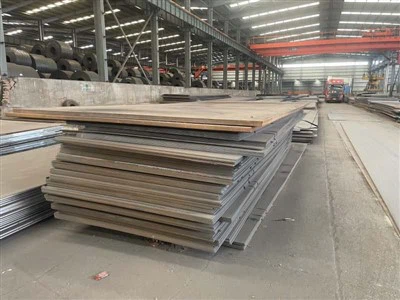
Yo! As a supplier of A516 Gr 70 Pressure Vessel Steel Plates, I often get asked about the difference between A516 Gr 70 and A516 Gr 60. So, I thought I'd take a stab at breaking it down in this blog post.
Chemical Composition
Let's start with the chemical stuff. The chemical composition of these two grades plays a huge role in their performance. Both A516 Gr 70 and A516 Gr 60 are mainly made up of elements like carbon, silicon, manganese, sulfur, and phosphorus. But the proportions are a bit different.
A516 Gr 70 generally has a slightly higher carbon content compared to A516 Gr 60. Carbon is like the muscle in steel. A bit more carbon can make the steel a bit stronger. But it's a delicate balance because too much carbon can also make the steel a bit brittle.
The manganese content in A516 Gr 70 is also a bit higher. Manganese helps with the strength and hardness of the steel, and it also improves the steel's ability to resist cracking.
Here's a quick comparison of the typical chemical composition:
| Element | A516 Gr 60 (%) | A516 Gr 70 (%) |
|---|---|---|
| Carbon | 0.31 max | 0.31 max (usually a bit higher in practice) |
| Manganese | 0.79 - 1.30 | 0.85 - 1.35 |
| Phosphorus | 0.035 max | 0.035 max |
| Sulfur | 0.035 max | 0.035 max |
| Silicon | 0.13 - 0.45 | 0.13 - 0.45 |
Mechanical Properties
Now, let's talk about how they perform. The mechanical properties of these steel plates are what really matter when it comes to using them in pressure vessels.
Tensile Strength
A516 Gr 70 has a higher tensile strength than A516 Gr 60. Tensile strength is a measure of how much pulling force a material can take before it breaks. For A516 Gr 60, the minimum tensile strength is around 400 - 550 MPa, while for A516 Gr 70, it's 485 - 620 MPa. This means that A516 Gr 70 can handle more stress and pressure, making it a better choice for high - pressure applications.
Yield Strength
The yield strength is the point at which the steel starts to deform permanently. A516 Gr 70 also has a higher yield strength. A516 Gr 60 has a minimum yield strength of about 205 MPa, and A516 Gr 70 has a minimum of 260 MPa. This higher yield strength gives A516 Gr 70 an edge when it comes to maintaining its shape under pressure.
Elongation
Elongation is how much a material can stretch before it breaks. A516 Gr 60 typically has a higher elongation percentage compared to A516 Gr 70. This means that A516 Gr 60 is a bit more ductile, or bendy. While this might seem like an advantage, in pressure vessel applications, the higher strength of A516 Gr 70 often takes precedence.
Applications
The differences in their properties lead to different applications.
A516 Gr 60 is commonly used in low to medium - pressure applications. It's a good all - around choice for pressure vessels that don't have to withstand extremely high pressures. For example, it can be used in small - scale boilers, some storage tanks, and simple pressure - containing equipment.
On the other hand, A516 Gr 70 is the go - to for high - pressure and high - stress applications. It's used in large industrial boilers, high - pressure storage vessels, and other critical pressure - vessel components. If you're dealing with a situation where the pressure is really high and safety is a top concern, A516 Gr 70 is the better option.


Cost
Cost is always a factor when choosing between materials. Generally, A516 Gr 70 is a bit more expensive than A516 Gr 60. This is mainly because of its higher strength and better performance characteristics. The additional processing and the slightly different chemical composition to achieve those properties add to the cost. But if you need the extra strength and reliability, the higher cost is often worth it.
Availability
As a supplier, I can tell you that both A516 Gr 70 and A516 Gr 60 are relatively easy to find. But sometimes, the demand for A516 Gr 70 is higher, especially in industries where high - pressure applications are common. So, there might be a bit more of a lead time to get your hands on A516 Gr 70, especially if you need a large quantity.
Related Products
If you're interested in other types of pressure vessel steel plates, you might want to check out these related products:
- ASTM A537 Class 1(A537CL1) Pressure Vessel And Boiler Steel Plate
- A516Gr70 Boiler Steel Plate
- SA516Gr.380 Pressure Vessel Plate
- A516 Gr70 Steel Metal Sheet For Boiler
- ASTM A516 Steel Plate
Wrapping It Up
So, to sum it all up, the main differences between A516 Gr 70 and A516 Gr 60 are in their chemical composition, mechanical properties, applications, cost, and availability. A516 Gr 70 is stronger, can handle more pressure, but is also a bit more expensive. A516 Gr 60 is more ductile and is a good choice for lower - pressure applications.
If you're in the market for A516 Gr 70 Pressure Vessel Steel Plates, or if you have any questions about which grade is right for your project, don't hesitate to reach out. I'm here to help you make the best decision for your needs. We can have a chat about the details of your application and figure out the perfect solution together.
References
- ASTM International standards for A516 Gr 60 and A516 Gr 70 pressure vessel steel plates.
- Industry publications on pressure vessel materials and applications.