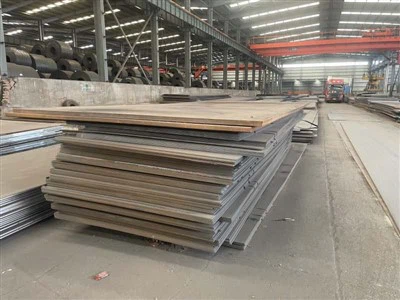
Corten steel, also known as weathering steel, is a group of steel alloys which were developed to eliminate the need for painting, and form a stable rust - like appearance after several years' exposure to weather. As a Corten steel supplier, I've had extensive experience with this remarkable material and understand the importance of its corrosion rates in different environments.
Corrosion Mechanism of Corten Steel
Before delving into the corrosion rates in different environments, it's essential to understand the basic corrosion mechanism of Corten steel. When Corten steel is exposed to the atmosphere, an initial layer of rust forms on its surface. Unlike ordinary steel, the alloying elements in Corten steel, such as copper, nickel, chromium, and phosphorus, react with oxygen and moisture in the air. These elements promote the formation of a dense, adherent, and protective oxide layer, also known as a patina. This patina acts as a barrier that slows down the further corrosion process.
Corrosion Rates in Rural Environments
Rural environments are characterized by relatively clean air with low levels of pollutants. The main corrosive agents in these areas are oxygen, moisture, and a small amount of natural pollutants like dust and pollen.
In rural settings, Corten steel generally exhibits a slow corrosion rate. The protective patina forms gradually over time, usually within the first one to three years of exposure. Once the patina is well - established, the corrosion rate can drop significantly. On average, the annual corrosion rate of Corten steel in rural environments may range from 0.1 to 0.3 mils per year (1 mil = 0.001 inches). This slow corrosion rate means that Corten steel structures in rural areas can last for decades with minimal maintenance. For example, a Corten steel sculpture in a rural park may maintain its structural integrity and aesthetic appeal for 50 years or more.
Corrosion Rates in Urban Environments
Urban environments are more complex in terms of corrosion factors. The air in cities contains higher levels of pollutants such as sulfur dioxide, nitrogen oxides, and particulate matter from vehicle emissions, industrial activities, and heating systems.
These pollutants can accelerate the initial corrosion process of Corten steel. In the early stages of exposure, the corrosion rate in urban environments may be two to three times higher than in rural areas, reaching up to 0.5 - 0.9 mils per year. However, if the conditions are favorable for the formation of a protective patina, the corrosion rate will eventually slow down. The presence of pollutants can sometimes make the patina formation more irregular, but once it is fully developed, it can still provide a certain degree of protection. It's important to note that in areas with high - traffic and heavy industrial pollution, the long - term corrosion rate may remain slightly higher than in rural areas, around 0.3 - 0.6 mils per year.
Corrosion Rates in Coastal Environments
Coastal environments pose a significant challenge to Corten steel due to the high concentration of salt in the air. Salt particles, mainly sodium chloride, are carried by sea breezes and deposited on the surface of the steel.


The salt acts as an electrolyte, accelerating the electrochemical corrosion process. In the initial stages of exposure to a coastal environment, the corrosion rate of Corten steel can be quite high, often exceeding 1 mil per year. The salt can prevent the formation of a uniform and protective patina, as it continuously disrupts the surface chemistry. Over time, if the steel is in an area with good air circulation and the salt deposition is not excessive, a modified patina may form. However, the long - term corrosion rate in coastal areas typically remains higher than in rural or urban environments, ranging from 0.5 to 1.5 mils per year. Structures made of Corten steel in coastal areas may require more frequent inspections and, in some cases, additional protective measures such as periodic cleaning to remove salt deposits.
Corrosion Rates in Industrial Environments
Industrial environments vary widely depending on the type of industry. For example, in chemical plants, the air may be filled with corrosive gases such as chlorine, sulfuric acid vapors, or ammonia. In power plants, there may be high levels of fly ash and sulfur - containing compounds.
In highly corrosive industrial environments, the corrosion rate of Corten steel can be extremely high. The initial corrosion rate can be several mils per year, and in some extreme cases, the steel may start to deteriorate rapidly. Even if a patina forms, it may be damaged by the continuous exposure to aggressive chemicals. In less severe industrial settings, where the pollution is mainly from general manufacturing processes, the corrosion rate may be in the range of 0.6 - 1.2 mils per year. In these environments, proper surface treatment and regular maintenance are often necessary to ensure the long - term performance of Corten steel structures.
Influence of Corten Steel Grades on Corrosion Rates
Different grades of Corten steel have different compositions, which can affect their corrosion resistance and rates. For instance, some high - quality Corten steel grades with optimized alloying elements may form a more protective patina more quickly and have lower corrosion rates in all environments compared to lower - grade counterparts.
As a Corten steel supplier, I offer a variety of Corten steel products, such as Q345B Carbon Steel Square Tube, Hot Rolled Weathering Corten Steel Plate, and Q460NH Weathering Steel Large Inventory. Each of these products is designed to meet different application requirements and environmental conditions. The Q345B Carbon Steel Square Tube has good strength and weldability, and is suitable for various structural applications in different environments. The Hot Rolled Weathering Corten Steel Plate is often used in large - scale construction projects, and its corrosion - resistant properties can ensure the long - term stability of the structure. The Q460NH Weathering Steel, with its large inventory, can provide a reliable supply for projects with high - volume requirements.
Factors Affecting the Corrosion Rate Beyond the Environment
Apart from the environment, several other factors can influence the corrosion rate of Corten steel. The surface finish of the steel plays an important role. A smooth surface may allow the patina to form more evenly, while a rough surface may have more areas prone to corrosion initiation. The orientation of the steel structure also matters. For example, a horizontal surface may collect more moisture and pollutants compared to a vertical surface, which can lead to a higher corrosion rate.
Contact for Purchase and Consultation
If you are considering using Corten steel for your project, it's crucial to understand the specific corrosion rates in your intended environment. As a professional Corten steel supplier, I can provide you with detailed information about the different grades of Corten steel and their performance in various conditions. Whether you need small - scale products for a DIY project or large - volume supplies for a commercial construction, I can offer customized solutions. Please feel free to contact me for further discussions on purchasing Corten steel products and to get the best advice for your specific needs.
References
- ASTM International. Standard Specification for High - Strength Low - Alloy Structural Steel with Atmospheric Corrosion Resistance. ASTM A588/A588M - 19.
- ISO 9223:2012. Corrosion of metals and alloys -- Corrosivity of atmospheres -- Classification, determination and estimation.
- Kucera, V., & Clifton, J. R. (1997). Atmospheric corrosion of metals. Elsevier Science.