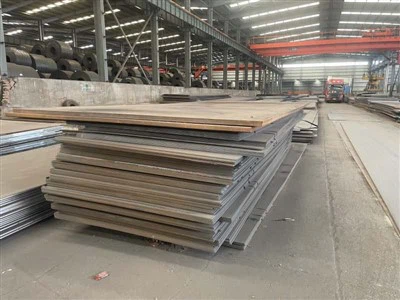
When it comes to the world of carbon steel plates, one of the most fundamental distinctions lies in the manufacturing processes of hot - rolled and cold - rolled steel. As a supplier of carbon steel plates, I've had the opportunity to witness firsthand the unique characteristics and applications of each type. In this blog, I'll delve into the differences between hot - rolled and cold - rolled carbon steel plates, helping you make informed decisions for your projects.
Manufacturing Processes
Hot - Rolled Carbon Steel Plate
Hot - rolled steel is produced at extremely high temperatures, typically above 1700°F (926°C). At this temperature, the steel is malleable and can be easily shaped. The process begins with heating a large steel billet or slab in a reheating furnace. Once the steel reaches the desired temperature, it is passed through a series of rolling mills. These mills compress and shape the steel into the desired thickness and width.


The high temperature during the rolling process allows the steel to expand and contract freely. As a result, hot - rolled steel has a characteristic scale on its surface, which is a thin layer of oxidized metal. This scale can be removed through various methods such as shot blasting or pickling, but it often remains on the steel when it is used in applications where appearance is not a major concern.
Cold - Rolled Carbon Steel Plate
Cold - rolled steel, on the other hand, starts as hot - rolled steel. After the initial hot - rolling process, the steel is further processed at room temperature. This involves passing the steel through a series of cold - rolling mills, which reduce the thickness and improve the surface finish of the steel.
The cold - rolling process is more precise than hot - rolling. It allows for tighter tolerances in terms of thickness and flatness. During cold - rolling, the steel is also work - hardened, which means its strength and hardness are increased. This is because the deformation of the steel at room temperature causes the grains within the steel to become more aligned, resulting in a stronger material.
Physical Characteristics
Surface Finish
One of the most obvious differences between hot - rolled and cold - rolled carbon steel plates is their surface finish. Hot - rolled steel has a rough, scaly surface due to the oxidation that occurs during the high - temperature rolling process. This surface finish is suitable for applications where appearance is not a priority, such as structural components in construction or industrial machinery.
Cold - rolled steel, on the other hand, has a smooth, shiny surface. The cold - rolling process eliminates the scale and imperfections on the surface of the steel, resulting in a more aesthetically pleasing finish. This makes cold - rolled steel ideal for applications where appearance is important, such as automotive parts, appliances, and furniture.
Dimensional Accuracy
Cold - rolled steel offers better dimensional accuracy than hot - rolled steel. The cold - rolling process allows for more precise control of the thickness and width of the steel plate. This is crucial in applications where tight tolerances are required, such as in the manufacturing of precision parts.
Hot - rolled steel, due to the expansion and contraction that occurs during the high - temperature rolling process, has slightly looser tolerances. While it is still suitable for many applications, it may not be the best choice for projects that require exact dimensions.
Mechanical Properties
The mechanical properties of hot - rolled and cold - rolled carbon steel plates also differ. Hot - rolled steel is generally more ductile than cold - rolled steel. Ductility refers to the ability of a material to deform under stress without breaking. This makes hot - rolled steel easier to form and weld, making it a popular choice for structural applications.
Cold - rolled steel, on the other hand, is stronger and harder due to the work - hardening that occurs during the cold - rolling process. It has a higher yield strength and tensile strength than hot - rolled steel. However, this increased strength comes at the cost of reduced ductility. Cold - rolled steel is more likely to crack or break under extreme stress compared to hot - rolled steel.
Applications
Hot - Rolled Carbon Steel Plate
Hot - rolled carbon steel plates are widely used in a variety of industries. In the construction industry, they are used for structural beams, columns, and frames. The large size and relatively low cost of hot - rolled steel make it an ideal choice for these applications. For example, in building a large commercial building, hot - rolled steel beams can provide the necessary strength and support at a reasonable cost.
In the manufacturing industry, hot - rolled steel is used for making heavy machinery parts, such as gears, axles, and crankshafts. The ductility of hot - rolled steel allows these parts to be easily formed and machined.
Cold - Rolled Carbon Steel Plate
Cold - rolled carbon steel plates are commonly used in applications where appearance and precision are important. In the automotive industry, cold - rolled steel is used for making body panels, doors, and hoods. The smooth surface finish of cold - rolled steel gives these parts a high - quality appearance, while the tight tolerances ensure a perfect fit.
In the appliance industry, cold - rolled steel is used for making refrigerators, washing machines, and other household appliances. The strength and hardness of cold - rolled steel make these appliances durable, while the smooth surface finish makes them easy to clean and maintain.
Specific Steel Plate Examples
There are several specific types of carbon steel plates that are available in both hot - rolled and cold - rolled forms. For instance, the Q355GJE is a high - strength structural steel plate. In hot - rolled form, it can be used for large - scale construction projects where its high strength and good weldability are crucial. In cold - rolled form, it can be used for more precise applications where a smooth surface and tight tolerances are required.
The S355 Carbon Steel Plate is another popular choice. Hot - rolled S355 steel plates are often used in general construction and engineering applications. Cold - rolled S355 steel plates, on the other hand, are used in applications where higher strength and better surface finish are needed, such as in the manufacturing of high - end machinery.
The A36 Steel Plate is a widely used carbon steel plate. Hot - rolled A36 steel is commonly used for structural applications due to its relatively low cost and good mechanical properties. Cold - rolled A36 steel is used for applications where a more precise and smooth finish is required, such as in the production of decorative metalwork.
Conclusion
In conclusion, the differences between hot - rolled and cold - rolled carbon steel plates are significant and have a direct impact on their applications. Hot - rolled steel is characterized by its rough surface finish, looser tolerances, and higher ductility, making it suitable for large - scale structural and industrial applications. Cold - rolled steel, on the other hand, offers a smooth surface finish, tight tolerances, and higher strength, making it ideal for applications where appearance and precision are important.
As a carbon steel plate supplier, I understand the unique requirements of different projects. Whether you need hot - rolled or cold - rolled carbon steel plates, I can provide you with high - quality products that meet your specific needs. If you are interested in purchasing carbon steel plates for your project, I encourage you to reach out to me for further discussion and to start the procurement process. I look forward to helping you find the perfect steel solution for your needs.
References
- ASM Handbook, Volume 1: Properties and Selection: Irons, Steels, and High - Performance Alloys
- Metals Handbook Desk Edition, Third Edition
- The Making, Shaping and Treating of Steel, Tenth Edition