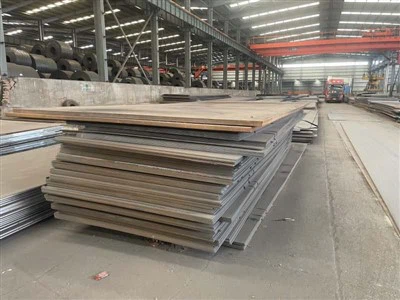
When it comes to bridge construction, the choice of materials is of paramount importance. One material that often comes under consideration is the S355jr Low Alloy High Strength Steel Plate. As a supplier of S355jr Low Alloy High Strength Steel Plate, I am well - versed in its properties and potential applications in bridge building. In this blog, I will explore whether this steel plate is a suitable option for bridge construction.
Properties of S355jr Low Alloy High Strength Steel Plate
High Strength
S355jr steel plate is classified as a low - alloy high - strength steel. It has a minimum yield strength of 355 MPa, which is significantly higher than some common carbon steels like A36 Steel. This high strength allows the steel to withstand heavy loads without excessive deformation. In bridge construction, bridges need to support the weight of vehicles, pedestrians, and sometimes even railway traffic. The high strength of S355jr steel plate means that less material can be used while still meeting the strength requirements. This can lead to cost savings in terms of material procurement and reduced dead load on the bridge structure.
Good Weldability
Welding is a crucial process in bridge construction as it is used to join different steel components together. S355jr steel plate exhibits good weldability. This means that it can be easily welded using common welding methods without significant risk of cracking or other welding defects. Good weldability ensures the integrity of the welded joints, which is essential for the overall strength and durability of the bridge. Compared to some high - strength steels that may require special welding procedures and pre - and post - weld heat treatments, the relatively easy - to - weld nature of S355jr simplifies the construction process and reduces construction time and cost.
Impact Resistance
Bridges are often exposed to dynamic loads, such as wind, seismic activity, and the impact of moving vehicles. S355jr steel plate has good impact resistance, especially at low temperatures. It can absorb a certain amount of energy during impact without fracturing. This property is vital for ensuring the safety of the bridge under various operating conditions. For example, in regions with cold climates, the steel needs to maintain its toughness and impact resistance to withstand sudden shocks and vibrations.
Corrosion Resistance
Although S355jr is not a stainless steel, it has better corrosion resistance compared to plain carbon steels. However, in bridge construction, especially for bridges located in areas with high humidity, near the coast, or in industrial areas with high levels of pollution, additional corrosion protection measures such as painting or galvanizing are usually required. Nevertheless, the inherent corrosion resistance of S355jr can provide a certain level of protection during the initial stages of the bridge's service life and reduce the frequency of maintenance.
Comparison with Other Steel Plates Used in Bridge Construction
A572 Grade 50 Steel Plate
A572 Grade 50 Steel Plate is another popular choice for bridge construction in the United States. It has similar strength properties to S355jr, with a minimum yield strength of 345 MPa. However, the chemical composition and manufacturing processes of the two steels may differ, which can affect their performance in specific applications. S355jr may have better weldability in some cases due to its specific alloying elements, which can make it a more suitable option for complex bridge structures that require a large number of welds.
A516 Grade 70 Plate
A516 Grade 70 Plate is mainly used for pressure vessels, but it can also be considered for bridge construction in some situations. It has a lower strength compared to S355jr, with a minimum yield strength of around 240 MPa. For bridges that require high - strength materials to support heavy loads, S355jr would be a more appropriate choice. However, A516 Grade 70 Plate may have better notch toughness in some applications, which could be an advantage in certain bridge designs.
ASTM A283Grade C(A283GRC) Carbon Steel Plate
ASTM A283Grade C(A283GRC) Carbon Steel Plate is a carbon steel with relatively low strength compared to S355jr. It has a minimum yield strength of about 185 MPa. While it may be more cost - effective in some simple bridge structures, S355jr is a better option for large - scale, high - load - bearing bridges due to its superior strength and better overall performance.
Suitability for Different Bridge Types
Beam Bridges
Beam bridges are one of the simplest types of bridges, consisting of horizontal beams supported at each end. S355jr steel plate is well - suited for beam bridges because of its high strength and good weldability. The high strength allows for the design of longer and lighter beams, reducing the number of supports required. The good weldability makes it easy to fabricate the beams and connect them to the supports.
Arch Bridges
Arch bridges rely on the arch shape to transfer loads to the abutments. S355jr can be used in arch bridge construction as it can withstand the compressive and tensile forces generated in the arch structure. Its high strength ensures the stability of the arch, and its impact resistance can help the bridge withstand dynamic loads such as traffic vibrations.
Suspension Bridges
Suspension bridges use cables to support the deck. Although the main cables are usually made of high - strength steel wires, S355jr can be used in the construction of the bridge deck, towers, and other components. Its high strength and good weldability make it suitable for fabricating these large - scale components.
Considerations in Using S355jr for Bridge Construction
Cost
The cost of S355jr steel plate is generally higher than that of some common carbon steels. However, when considering the long - term benefits such as reduced material usage, lower maintenance costs, and longer service life, the overall cost - effectiveness of using S355jr in bridge construction can be quite high. Bridge designers and contractors need to conduct a detailed cost - benefit analysis to determine whether the use of S355jr is economically viable for a particular project.
Design and Engineering
The use of S355jr in bridge construction requires proper design and engineering. Engineers need to take into account the properties of the steel, such as its strength, weldability, and corrosion resistance, when designing the bridge structure. They also need to ensure that the welding procedures and construction techniques are appropriate for S355jr to ensure the safety and durability of the bridge.
Quality Control
As a supplier, I understand the importance of quality control. The S355jr steel plates need to meet the relevant international standards and specifications. Quality control measures should be implemented throughout the manufacturing process, from raw material selection to final product inspection. This ensures that the steel plates used in bridge construction have consistent quality and performance.
Conclusion
In conclusion, S355jr Low Alloy High Strength Steel Plate is a highly suitable material for bridge construction. Its high strength, good weldability, impact resistance, and relatively good corrosion resistance make it an excellent choice for various types of bridges. When compared to other steel plates commonly used in bridge construction, it offers a combination of superior performance and cost - effectiveness in many cases.
If you are involved in bridge construction projects and are considering the use of S355jr Low Alloy High Strength Steel Plate, I encourage you to contact me for more information. We can discuss your specific requirements, and I can provide you with high - quality steel plates and professional technical support.

References
- "Steel Structures Design and Practice" by Subramanian N.
- "Bridge Engineering Handbook" by Wei - Bin Zhang.