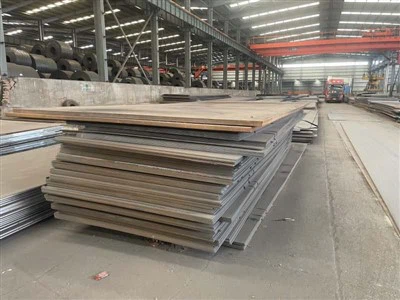
Shipbuilding is a complex and demanding industry that requires materials of the highest quality to ensure the safety and durability of vessels. Among the various materials used, steel plates play a crucial role, with AH36, DH36, and EH36 being some of the most commonly utilized grades for shipbuilding. As a trusted AH36, DH36, EH36 Steel Plate For Shipbuilding supplier, we understand the importance of these steel grades and the differences between them. In this blog post, we will explore the main disparities in their chemical composition, mechanical properties, and applications, providing valuable insights for shipbuilders and industry professionals.
Chemical Composition
The chemical composition of steel greatly influences its properties and performance. AH36, DH36, and EH36 steel plates share some similarities in their base elements but also have distinct differences due to specific alloying elements added to meet different requirements.


All three grades are low-alloy, high-strength structural steels, with the primary element being iron (Fe). They also contain carbon (C), manganese (Mn), silicon (Si), phosphorus (P), sulfur (S), and small amounts of other elements. Carbon is a key element that affects the strength and hardness of steel. In general, the carbon content in AH36, DH36, and EH36 is relatively low, typically around 0.18% - 0.20%, which helps maintain good weldability and ductility.
Manganese is added to improve the strength and toughness of steel. It also enhances the hardenability of the material. The manganese content in these grades is typically in the range of 1.00% - 1.60%. Silicon is used as a deoxidizer during the steelmaking process and can also contribute to improving the strength of the steel.
One of the main differences between the three grades lies in their impact toughness requirements, which are achieved through different levels of alloying elements and control of impurities. AH36 steel is designed for general shipbuilding applications where the vessel may operate in relatively mild environmental conditions. It has a relatively lower impact toughness requirement compared to DH36 and EH36.
DH36 steel is an upgrade from AH36 and is suitable for use in ships that will encounter more severe service conditions, such as in cold regions. To achieve better impact toughness, DH36 steel has stricter control over the sulfur and phosphorus content, which are impurities that can reduce the toughness of the steel. The sulfur content in DH36 is typically limited to a maximum of 0.030%, and the phosphorus content to a maximum of 0.035%.
EH36 steel is the highest grade among the three and is specifically designed for ships operating in extremely cold environments. It has even more stringent requirements for impact toughness, and to meet these requirements, additional alloying elements such as nickel (Ni) may be added. The sulfur and phosphorus content in EH36 is further reduced compared to DH36, with a maximum sulfur content of 0.025% and a maximum phosphorus content of 0.030%. This tight control of impurities and the addition of alloying elements ensure that EH36 steel maintains its toughness and ductility at very low temperatures.
Mechanical Properties
The mechanical properties of steel plates are critical for shipbuilding applications, as they determine the ability of the vessel to withstand various loads and stresses during its service life. The main mechanical properties considered for AH36, DH36, and EH36 steel plates include yield strength, tensile strength, elongation, and impact toughness.
Yield Strength and Tensile Strength: All three grades have a minimum yield strength of 355 MPa, which means they can withstand a certain amount of stress before permanent deformation occurs. The tensile strength, which is the maximum stress the steel can withstand before breaking, is typically in the range of 490 - 620 MPa for all three grades. These high strength values make them suitable for constructing the structural components of ships, such as hulls, decks, and bulkheads.
Elongation: Elongation is a measure of the ability of the steel to stretch before fracturing. It is an important property for shipbuilding as it indicates the ductility of the material. A higher elongation value means the steel can deform plastically without breaking, which is beneficial during the fabrication process and when the ship is subjected to dynamic loads. AH36, DH36, and EH36 steel plates generally have a minimum elongation of 21% for a gauge length of 50 mm, which ensures good ductility.
Impact Toughness: This is where the significant differences between the three grades become apparent. Impact toughness is the ability of the steel to absorb energy during impact loading, and it is especially important for ships operating in cold environments where the risk of brittle fracture is higher.
AH36 steel has an impact toughness requirement of at least 27 J at 0°C. This means that at 0°C, the steel can absorb a minimum of 27 joules of energy before fracturing under impact. DH36 steel, designed for more severe conditions, has a higher impact toughness requirement of at least 27 J at -20°C. This shows that DH36 can maintain its toughness at lower temperatures compared to AH36.
EH36 steel, as the highest grade, has the most stringent impact toughness requirement, with a minimum of 27 J at -40°C. This excellent low-temperature toughness makes EH36 suitable for ships navigating in Arctic or Antarctic waters, where the temperatures can drop well below -20°C.
Applications
The differences in chemical composition and mechanical properties of AH36, DH36, and EH36 steel plates lead to their specific applications in shipbuilding.
AH36 Steel Plate: Due to its relatively lower impact toughness requirement and cost-effectiveness, AH36 steel is widely used in general shipbuilding applications. It is commonly employed in the construction of the main hull structure, decks, and internal bulkheads of ships that operate in temperate regions or in areas with relatively mild environmental conditions. For example, coastal vessels, small to medium-sized cargo ships, and some fishing boats may use AH36 steel plates.
DH36 Steel Plate: With its improved impact toughness at lower temperatures, DH36 steel is preferred for ships that may operate in cold regions, such as the North Sea or the Baltic Sea. It is used in the construction of offshore support vessels, ice-class vessels, and some large ocean - going cargo ships. The better low - temperature properties of DH36 ensure the safety and integrity of the ship's structure in colder waters.
EH36 Steel Plate: EH36 steel is the top choice for ships operating in extremely cold environments, such as Arctic exploration vessels, icebreakers, and ships involved in deep - sea oil and gas exploration in cold regions. The high impact toughness at -40°C makes it capable of withstanding the harsh conditions and potential ice impacts in these areas.
In addition to shipbuilding, these steel grades also have applications in other industries where high - strength and good toughness are required. For example, they can be used in the construction of offshore platforms, bridges, and some heavy machinery.
Other Related Shipbuilding Steel Plates
In the shipbuilding industry, there are other types of steel plates that also play important roles. The EH32 Shipbuilding Steel Plate is another grade with good low - temperature toughness, similar to EH36 but with relatively lower strength. It is often used in some less demanding cold - water applications.
The CCS A Shipbuilding Steel Plate is a grade recognized by the China Classification Society. It is used in shipbuilding projects that follow the CCS rules and is suitable for general ship construction in various environments.
The ASTM A131 / BV / LR Grade B Shipbuilding Steel Plate meets the standards of ASTM A131, Bureau Veritas (BV), and Lloyd's Register (LR). It is a commonly used grade for small to medium - sized ships and has good weldability and mechanical properties.
The FH32 Shipbuilding Steel Plate is designed for ships that need to meet high - performance requirements, especially in terms of fatigue resistance. It is often used in the construction of high - speed vessels and some specialized ships.
Conclusion
In conclusion, AH36, DH36, and EH36 steel plates have distinct differences in their chemical composition, mechanical properties, and applications. As a AH36, DH36, EH36 Steel Plate For Shipbuilding supplier, we are well - aware of these differences and can provide the right steel grade according to your specific shipbuilding needs. Whether you are building a coastal vessel, an ice - class ship, or an Arctic exploration vessel, choosing the appropriate steel grade is crucial for ensuring the safety and performance of your ship.
If you are involved in shipbuilding or other industries that require high - quality steel plates, we invite you to contact us for more information and to discuss your procurement needs. Our team of experts is ready to assist you in selecting the most suitable steel grade and providing you with the best products and services.
References
- Shipbuilding Steel Standards and Specifications, International Association of Classification Societies.
- "Steel for Shipbuilding: Properties and Applications", Maritime Engineering Journal.
- National Shipbuilding Research Program Reports on Steel Materials for Ship Structures.